Why B2B social media needs its own platform architecture





Table of contents
- What does "Built for B2B" really mean?
- Built for B2B: Key features you need in a social media platform
- Why B2C platforms fall short for B2B marketers
- Why leading B2B brands choose Oktopost
- When platform architecture determines marketing outcomes
- Where Oktopost's competitors fall short
- Choosing the right social platform for B2B growth
Most social media management platforms weren’t born for the B2B world. They were designed for fast-moving consumer brands, built around likes and impressions, for multiple platforms (Facebook, Instagram, TikTok) and many daily posts. They excel at helping brands that have to schedule and post constantly.
But as you know, B2B is different.
Your teams work across multiple regions, product lines, and compliance workflows. Your buyers move slowly, evaluate carefully, and bring five to eight stakeholders into a deal. And most importantly, your job is to influence revenue, not rack up likes.
A social media management platform can market itself as “B2B-ready,” but that’s not the same as being built for B2B from day one. In this article, we unpack the real architectural differences between B2B-built platforms and tools that later retrofitted B2B features. Then we’ll compare the leading players to see who truly serves the complexity of modern B2B marketing.
What does “Built for B2B” really mean?
Platforms designed for the B2C world were built with a completely different set of priorities: high post volume, rapid-fire content cycles, and surface-level vanity metrics that help brands stay top of mind with broad consumer audiences.
In that environment, success is measured in impressions, likes, and real-time reactions, not in multi-month nurturing or account-level influence. These platforms excel at helping consumer brands publish frequently and react quickly. But that same architecture makes it difficult to support the more complex, orchestrated workflows that define B2B marketing.
B2B leaders need platforms architected for different priorities:
Pipeline visibility
B2B marketing is accountable for revenue, not impressions, even though many social media managers think that metrics such as reach and engagement are the main drivers. This is because platforms built for B2B are siloed from the metrics marketing needs to track and the impact it has. Specifically, organic social is all too often seen as a media channel or marketing tactic that is too difficult to measure. Because measurement is complex on other platforms, organic social is more often viewed as a brand-awareness lever than a revenue driver. A platform built for B2B social engagement must connect directly to leads, accounts, opportunities, and influenced revenue. Platforms need to track long-cycle impact and surface where deals accelerate or stall.
Multi-stakeholder influence & long sales cycles
B2B purchases involve multiple evaluators from finance, IT, leadership, procurement, and end-users. The process often involves 5–8 people or more, and recently, Forrester Research found that the average B2B buying cycle involves 13 people. In addition, Gartner insights show that the B2B buying process includes unhealthy conflicts that require agreement and budget approval. A B2B-first platform must help map engagement across all these stakeholders and accounts, not just the individual who clicked.
Compliance and brand consistency
Enterprises, especially in regulated sectors, need airtight workflows to avoid risk and maintain global brand quality. B2B social media managers must stay on top of approvals and be able to produce audit trails. That same rigor that keeps organizations compliant is what also keeps their message consistent. And in B2B, consistency is a form of compliance itself, shaping how prospects perceive credibility, stability, and reliability across every region.
CRM/MAP intelligence
B2B social can’t exist as an isolated channel. It must deeply integrate with marketing automation and CRM so that every click, share, or interaction enriches lead scoring, nurturing, account journeys, and pipeline visibility.
Built for B2B: Key features you need in a social media platform
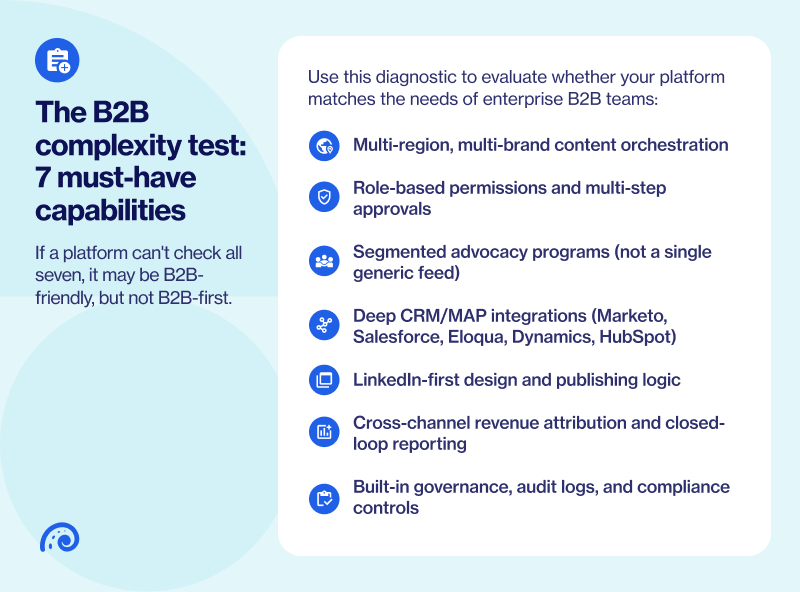
True B2B platforms are built around operational complexity, including:
- Multi-brand & multi-region hierarchy: Enterprise marketers need a granular structure, not a flat content calendar.
- Advanced approval layers: Legal, brand, product, and comms all need clear workflows.
- Deep CRM/MAP connectivity: Native connections to Salesforce, Marketo, Eloqua, Dynamics, and HubSpot. Webhooks or Zapier workarounds are not ideal.
- Deal-cycle visibility: Social activity tied to account journeys, lead scoring, and opportunity influence.
- Integrated employee & executive layers: Advocacy shouldn’t be its own silo; it must work across publishing, analytics, and campaigns.
- Compliance and governance built into the UX: Audit trails. Permissioning. Brand control. All built in from day one.
Why B2C platforms fall short for B2B marketers
When B2C-origin platforms try to “adapt” to B2B, cracks appear. Cracks show up in a social media manager’s day-to-day work and when they need to report the business impact of B2B organic social. Often, features are added as disconnected modules.
Scenario: You publish from one dashboard, manage advocacy in another, ghostwrite for execs on a Google doc, and track analytics in a third. Then you have to stitch reports together manually because the systems don’t integrate. Social attribution becomes patchy
Scenario: You see a spike in clicks on a high-value post, but when Sales asks which accounts engaged with it or whether it influenced an open opportunity, you have no reliable way to answer. Advocacy sits in its own workflow with limited reporting
Scenario: Employees share content through a separate app, but you can’t track which advocacy posts drive traffic, leads, or pipeline, or even which teams are contributing most. You can’t connect advocacy posts to marketing campaign topics; you must review things manually. Compliance controls are bolt-ons
Scenario: Before a big product announcement, you’re forced to chase legal and brand approvals in Slack or email because the platform doesn’t support multi-step workflows or audit trails.
CRM/MAP integrations are shallow or read-only
Scenario: You push UTM links into Salesforce, but social clicks never enrich lead scores, trigger nurturing sequences, or appear in account timelines. Marketing Ops has to manually recreate missing data. This isn’t because these platforms are “bad”. They were never meant to carry B2B complexity at scale. Their architecture reflects the fast-turn, high-volume priorities of consumer marketing, not the long-cycle, multi-stakeholder realities of B2B.
Why leading B2B brands choose Oktopost
The growth of social media has made LinkedIn and other networks primary channels for B2B decision-makers to discover. But it soon became clear that the market needed a revenue-focused social platform.
As professional social media matured, B2B marketers needed:
- Attribution, not impressions
- Lead scoring, not vanity metrics
- CRM visibility, not channel silos
- Advocacy is integrated across departments
These requirements demanded an entirely new architecture built specifically for the B2B motion. Oktopost’s architecture reflects its B2B-first DNA:
- One unified platform: Publishing, social listening, advocacy, analytics, BI, CRM/MAP data. All connected. All pulling in the same direction.
- Advocacy integrated directly into workflows: Use cases across Microsoft Teams, Slack, Salesforce, and internal tools.
- Executive-level social visibility: Ghostwriting, delegated approval, and content feeds tailored to leadership.
- Governance baked into the platform: Enterprise roles, permissions, approvals, audit trails. Baked in, not retrofitted as an afterthought.
When platform architecture determines marketing outcomes
Kainos moves from social engagement to closed revenue
When Kainos set out to prove the impact of B2B social media on revenue, they needed hard data that aligned with B2B sales cycles. With Oktopost’s native Marketo and Microsoft Dynamics integrations, Kainos gained accurate account-level visibility, enriched lead scores, and surfaced sales-ready prospects based on social interactions.
This closed long-standing knowledge gaps and helped sales prioritize higher-quality leads. The result wasn’t a better “social presence”. It was the ability to tie conference and campaign engagement directly to opportunities, closed deals, and a 581% ROI. That level of attribution is harder to set up on platforms that have been retrofitted from B2C.
Planview: built for enterprise B2B complexity
Planview needed to manage global social efforts and employee advocacy for 700+ employees, without sacrificing attribution or CRM alignment. Oktopost gave them a single platform for publishing, advocacy, and performance measurement, resulting in a 22% increase in qualified leads from social. Not more impressions. More pipeline.
Their success shows why consolidation only works when your platform is architected for B2B workflows from day one. If it isn’t, teams end up stitching together tools designed for consumer use cases and losing the data that matters most.
Where Oktopost’s competitors fall short
B2C-origin platforms
These tools were initially designed for high-volume social publishing, not the operational and data requirements of B2B teams. Their architectures naturally reflect the priorities of real-time, consumer-oriented social activity rather than long, multi-stakeholder sales cycles.
- Minimal attribution depth: Reporting focuses on clicks, reach, and engagement metrics but does not track influence on leads or deal progression.
- Advocacy missing or disconnected: Advocacy tools (if available) operate separately from the main publishing environment, creating fragmentation.
- Limited CRM/MAP integration: Connectors often rely on UTMs or third-party bridges and don’t provide the bidirectional data sync required for account intelligence.
- Governance not built for enterprise needs: Permissioning, approval flows, and audit trails are minimal or basic, offering limited support for compliance-driven workflows.
Hybrid platforms:
These platforms provide broad social features used across many industries, but their architectures were shaped around SMB and mid-market needs rather than enterprise B2B operational complexity.
- Built for SMB and mid-market first: Their workflow and governance models reflect the needs of smaller teams.
- Advocacy is modular, delivered as a separate add-on rather than an integrated part of the platform.
- CRM integration is shallow (Sprout) or not social-first (HubSpot): Sprout’s CRM connections primarily push engagement data outward without enabling revenue workflows, while HubSpot’s social tools sit atop a CRM that isn’t designed to capture granular social intent signals.
Enterprise suite:
Sprinklr is built as a broad, multi-product enterprise ecosystem covering dozens of digital functions. Its breadth can create complexity that overshadows the specific needs of B2B marketing teams.
- Overly broad product suite: With many modules and functions, configuring a streamlined B2B marketing motion requires customization and cross-module alignment.
- Complex implementation: Deployments often involve long onboarding cycles and require dedicated internal or external admin resources.
- High-cost, heavy workflows: The platform’s scale introduces overhead beyond what a B2B marketing team typically needs to run social and advocacy.
- B2B-specific use cases are diluted: Because the platform serves numerous industries and functions, its workflows and reporting are not explicitly optimized for the B2B buyer’s journey or the multi-stakeholder pipeline.
Choosing the right social platform for B2B growth
When a platform’s architecture aligns with how B2B organizations operate, the benefits spread quickly across the entire go-to-market engine. Attribution becomes more accurate, enabling smarter budget decisions and more explicit conversations with revenue teams. Governance is stronger, reducing compliance risks and ensuring every post meets legal and brand standards. Advocacy programs become easier to scale and measure, expanding reach through employees and executives without creating new reporting gaps.
At the same time, LinkedIn, the most crucial channel for B2B, gets the attention and optimization it requires. Regional teams stay aligned under a unified brand voice, and data finally flows directly from social activity to pipeline and closed revenue. Book a personalized demo and see how B2B-first architecture shifts the conversation from social “presence” to social performance.
Frequently asked questions
Download this guide to see why customers choose Oktopost over alternatives
Download: Why B2B social media needs its own platform architecture