Choose a B2B social media solution backed by a B2B-first team




Table of contents
Why your B2B social media platform’s team matters
B2B social media platform evaluations begin with functionality.
Can it handle B2B complexity?
Does it support LinkedIn, advocacy, and attribution in a way that aligns with revenue goals?
Every B2B social media marketer needs to check these boxes. After checking them, most teams move on. Few stop to examine the vendor itself. Yet the makeup of the team supporting the solution often has as much impact on outcomes as the technology.
In a market where feature parity is increasingly common, outcomes are not. The difference rarely comes down to dashboards or workflows alone. It comes down to the people behind the platform, and whether they understand how B2B marketing actually works.
The hidden factor in B2B social success: a team that understands B2B
B2B social media isn’t just “social media with longer posts.” It operates under different conditions:
- Longer and less predictable buying cycles.
- Multiple stakeholders are involved at different stages.
- A heavy emphasis on LinkedIn as the primary engagement channel.
- Tight alignment with Sales, RevOps, and Marketing Ops.
- Governance, compliance, and brand control requirements.
Each of these realities changes how B2B marketers plan and measure their social media activity.
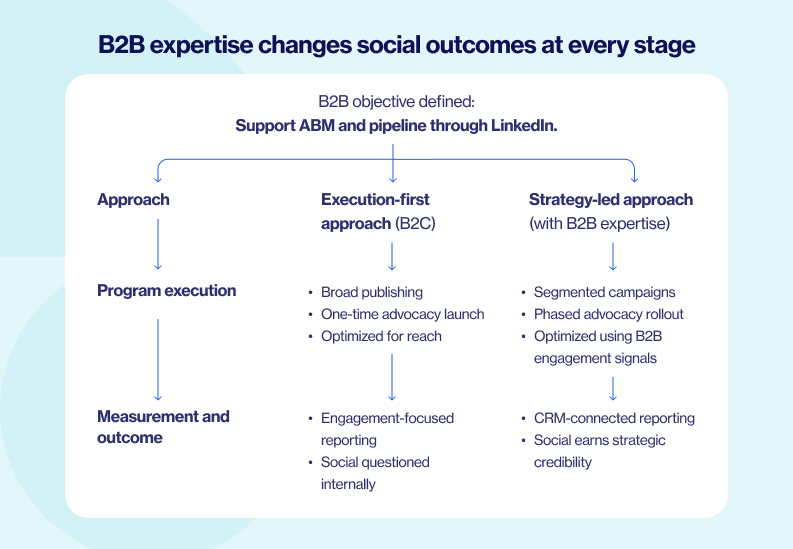
Platforms that originated in B2C environments often struggle here. The technology is sound, but their internal teams are trained for different goals to the ones that B2B marketers are trying to achieve. The guidance they offer businesses typically aims for speed, volume, and surface-level engagement. Strategic influence across a complex go-to-market motion, a staple of B2B social media marketing, falls outside of scope.
Going beyond software: what true B2B support looks like
When vendors say they “go beyond software,” it’s worth unpacking what that means in practice. For B2B teams, a real partnership usually shows up in four distinct ways.
1. Dedicated B2B expertise, not generalist support
In a B2B-first model, every interaction is with someone who understands how social fits into the broader revenue engine, not just how to publish a post.
That includes fluency in:
- B2B funnels and multi-touch buyer journeys
- CRM and marketing automation integrations
- Attribution models that connect social engagement to the pipeline
- The realities of compliance-heavy or regulated industries
This distinction becomes especially clear when teams start asking higher-order questions. In B2B, “How do I schedule this?” is less important than “How should this campaign support demand gen?” or “How do we structure advocacy across regions and roles?”
Generalist platforms typically can’t answer those questions well because their teams are trained to resolve feature-related issues. B2B-first vendors train teams to help customers design programs that align with real business outcomes.
2. Strategic guidance beyond ticket resolution
Most platforms are built around a reactive support model. You encounter an issue and submit a ticket. That approach works for basic functionality. It breaks down when B2B teams are trying to mature their social strategy.
At that stage, marketers need guidance on things like:
- Rolling out employee advocacy in phases: “Can you suggest a rollout sequence that makes sense, so we can test adoption and refine the program before scaling up?
- Aligning LinkedIn activity with account-based or demand gen motions: How have you seen teams align LinkedIn activity with existing ABM and demand gen programs so it reinforces active campaigns?
- Structuring attribution so social performance resonates with leadership: What level of attribution should I really care about for leadership when social is one of several influencing channels?
- Optimizing LinkedIn content based on real engagement signals: Which engagement signals should I be focusing on in my monthlies with management?
This is where proactive Account managers and Solution managers become a force multiplier. Instead of responding to problems, they help teams identify opportunities and refine strategy before performance stalls.
3. Education that builds skills, not just product familiarity
Adoption rarely fails because teams don’t know where to click.
It fails because they’re unsure why they’re doing something or how it ties to impact.
That’s why education matters so much in B2B environments.
Effective enablement goes beyond onboarding checklists and help docs. It includes:
- Structured B2B marketing training programs that explain B2B social strategy end-to-end.
- Certifications that give teams a shared language and confidence.
- Live sessions that adapt to evolving platforms, priorities, and KPIs.
B2B social marketers need the right skills and insights to be highly effective B2B social strategists. The platform you choose to support your B2B social media marketing efforts should help them acquire and develop those capabilities.
4. A real B2B community
One of the fastest ways B2B teams plateau is isolation.
Without exposure to how peers handle advocacy adoption, attribution challenges, or executive visibility, teams often default to safe, familiar tactics. Even if those tactics aren’t effective, it makes sense that teams resort to them to feel like they’re at least moving something forward.
A true B2B partner actively creates space for:
- Peer learning across industries and regions.
- Expert-led discussions grounded in real B2B use cases.
- Conversations that focus on outcomes and how to achieve them.
Community equips teams to find creative routes around stagnation and keep evolving their approach as expectations rise.

Customer success stories: B2B social at its best
When technology is paired with human expertise, the results compound over time.
Beyond Bank
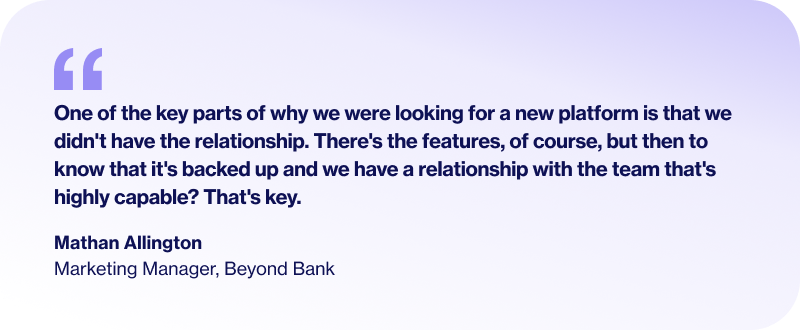
Beyond Bank partnered with Oktopost to evolve its social strategy from reactive support to proactive relationship-building. With expert guidance and a phased advocacy rollout, the team scaled LinkedIn engagement and built a foundation designed to grow with the business.
CBIZ
With structured training and advocacy enablement from Oktopost, CBIZ’s social media team scaled social selling while maintaining consistent adoption. Social engagement could be evaluated alongside revenue activity instead of in isolation.
Corel
Through training and ongoing enablement from Oktopost, Corel embedded employee advocacy into its broader marketing approach. Clear guidance and employee-facing insights helped ensure consistent, sustainable participation over time.
In each case, sustained impact stemmed from the B2B-specific enablement provided by Oktopost’s team.
Frequently asked questions
Download this guide to see why customers choose Oktopost over alternatives
Download: Choose a B2B social media solution backed by a B2B-first team