


- Customer support is reactive, resolving specific issues; customer success is proactive, driving ongoing value.
- Support is measured by metrics like first response time; success is measured by retention and churn rates.
- Customer success is a newer discipline, giving companies room to differentiate through original approaches.
- The two functions work best when connected, since success can flag issues before they become support tickets.
If you’re involved in client relations for a B2B or SaaS company, you’ve probably heard the terms “customer support” and “customer success.” While they might sound like perfect synonyms, the truth is that each one refers to something a little different.
In this article, we’ll explain the difference between customer support and customer success and what it means for your brand. Finally, we’ll give you four ways to elevate the customer experience for both.
Quicklinks
- What is Customer Success?
- What is Customer Support?
- What’s the Difference Between Customer Success and Customer Support?
- How Customer Success and Customer Support Synergize
What is customer success?
Customer success is the ongoing process of helping clients get more out of a product or service. In short, customer success is about making sure your customers don’t miss out on any opportunities to take advantage of what you offer.
Naturally, the details of customer success vary depending on the specific relationship you have with clients. For example, some B2B providers offer regular strategy meetings to align goals and tactics. Others may provide training sessions for certain aspects of their product so that clients can implement their own ideas more effectively.
What is customer support?
Customer support is the process of responding to questions, technical issues, and other concerns from your users. While customer success interactions often start on your end, customer support generally starts when your clients ask you to solve a particular problem.
That said, you don’t always need to have a one-on-one conversation for effective customer support. For example, knowledge bases and FAQ sections answer common questions while removing the need for a human agent. The key point is that customer support is about getting your clients back on track after something goes wrong.
What’s the difference between customer success and customer support?
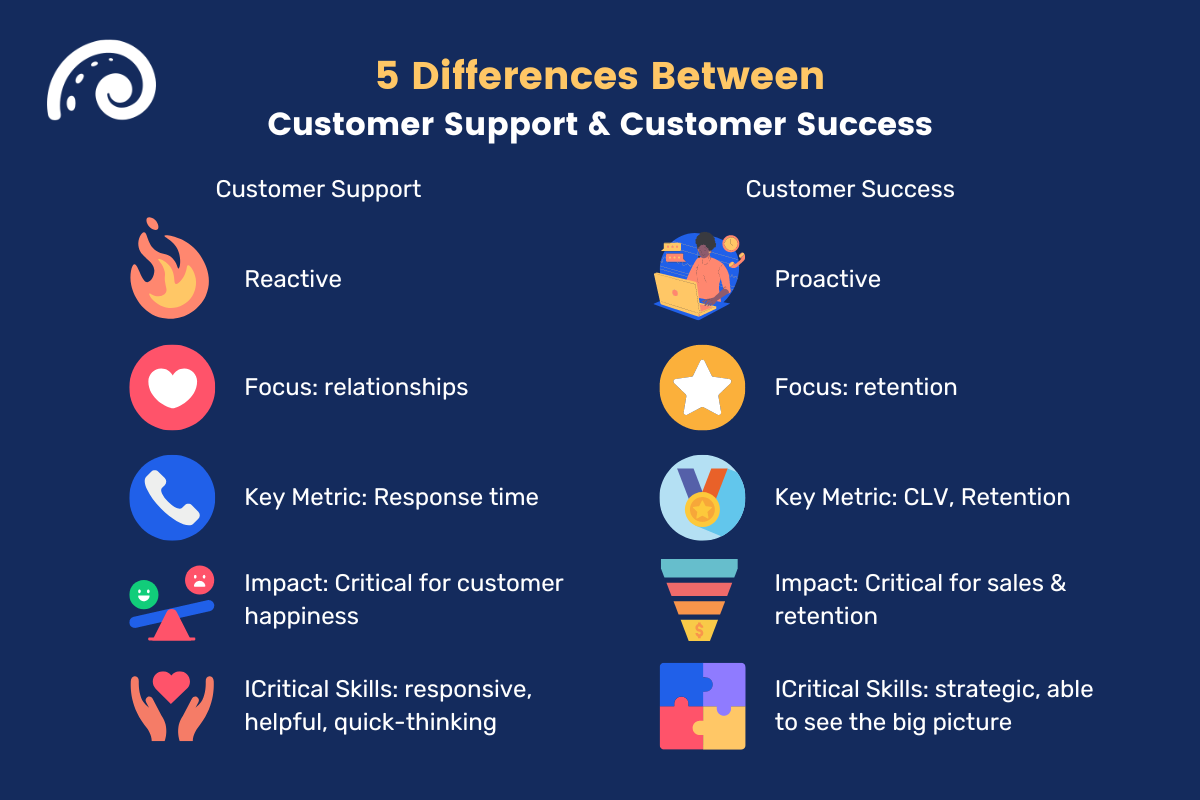
1. Methodology: proactivity vs. reactivity
When a client reaches out to your customer support team, they have a question about a specific issue — usually one that has a negative impact on their experience. From there, your goal is to resolve that problem so they can return to using your product or service as usual.
While customer support interactions revolve around something particular, customer success is ongoing. You don’t have to wait for clients to contact you — customer success works best when you’re reaching out to improve their experience. With that in mind, strong customer success practices will also help reduce your support workload by keeping clients on track and helping to prevent common issues.
2. Objectives: relationship-building vs. sales-focused
Client relationships are critical for many different kinds of businesses. However, customer support inquiries focus more on the issue at hand than your relationship with that particular client. You and the client want to resolve the problem quickly rather than working on your overall relationship.
On the other hand, customer success depends on consistent interactions that keep the client engaged with your brand. Instead of simply solving problems, you should be proactive to help your clients get more out of your product or service.
For example, many B2B companies offer extended onboarding sessions. If your product or service has complicated features, you may also need to provide training so that your clients understand how to take advantage of them. Your customer support staff will be able to fix problems, but clients need strong customer success teams to help them understand the full potential of your offering.
3. Measurement: support vs. success metrics
Since customer support involves specific problems, successes, and failures are relatively easy to measure. Managers are typically interested in some basic metrics, such as:
- First response time
- Total resolution time
- Percentage of tickets that are reopened after the initial interaction
- CSAT (customer satisfaction score)
- NPS (net promoter score)
Some companies also gather user feedback to learn more about the customer support experience they offer.
In contrast, customer success is more difficult to measure directly. The goal isn’t to troubleshoot a specific issue in the moment, but rather to improve client relationships and experiences over longer periods of time.
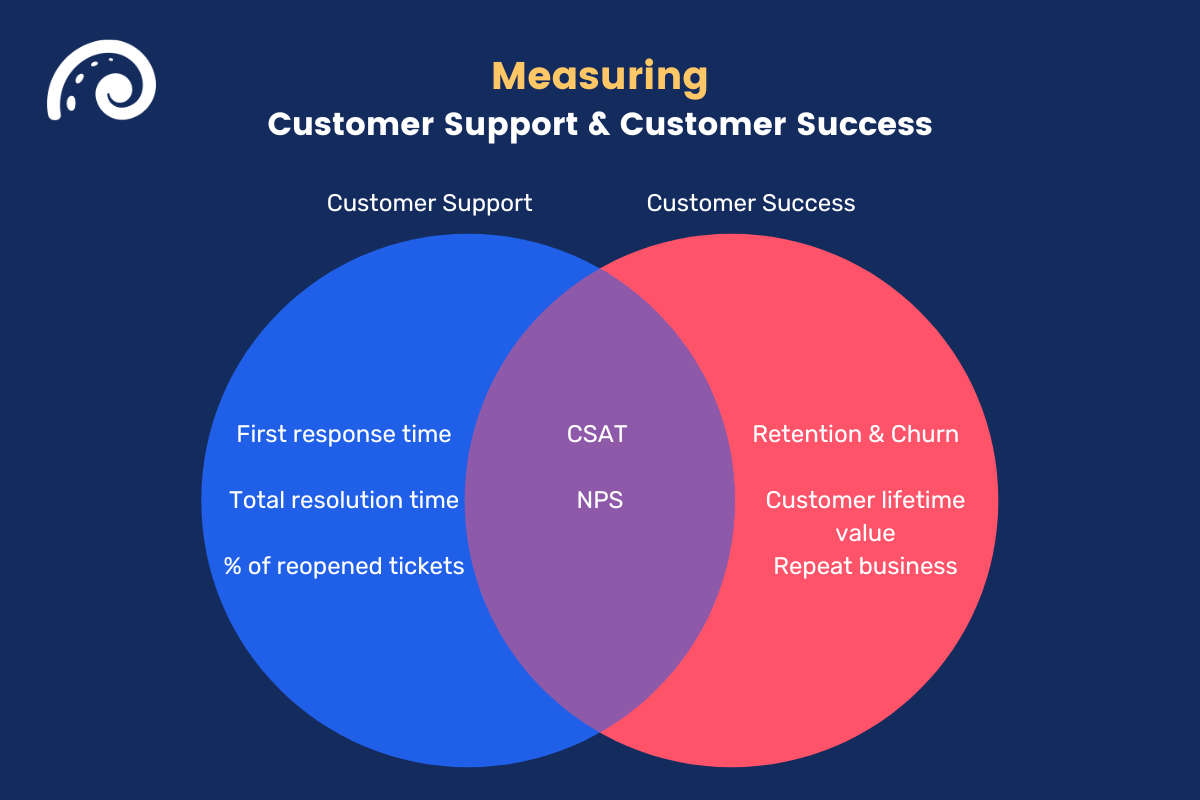
Effective customer success strategies may be reflected in statistics like
- Retention and churn rates
- Lifetime customer value
- Repeat orders
- CSAT (customer satisfaction score)
- NPS (net promoter score)
Fortunately, scores like CSAT and NPS can be used for customer support and success (along with other areas of your business). Unfortunately, it can be difficult to determine how much of those metrics come from customer success and how much comes from other areas of your business.
4. Impact: customer support vs. customer success impact on B2B
Customer support is an established field, and many companies use standard customer support practices. For example, businesses often provide a knowledge base, FAQ, or help center that includes answers to common questions. Some also offer training videos or guides to help customers get up and running independently.
It’s common to find direct customer support offered through channels like email, phone, live chat, and service tickets. Since these processes are so widespread, it’s easy even for small businesses to start a basic customer support workflow by following standard practices. Avoiding delays, effectively training your support team, and offering different kinds of support will help improve your outcomes.
On the other hand, customer success has only been around for a short time. Different companies have implemented customer success strategies differently, and there’s no clear blueprint for businesses that want to move in that direction.
This presents both challenges and opportunities for companies in 2022. The downside is that customer success is more challenging to enter—you’ll have to develop new ideas that make sense for your unique business. It will probably take you much longer to get started with customer success than customer support.
Fortunately, this also means you’ll be able to differentiate your brand. Customer success strategies vary widely between companies, and some businesses don’t have clarified customer success practices. There’s a real chance for newcomers to outperform the competition and attract clients away from other businesses in the same niche.
5. Skillsets: customer support vs. customer success initiatives
The dynamic described above also leads hiring managers to look for different skills in customer support candidates compared to customer success.
Customer support relies on a few standard skills. Representatives must be responsive, helpful, and effective at dealing with unpredictable clients. An effective customer support employee will resolve most issues quickly so clients are satisfied without wasting unnecessary time.
On the other hand, customer success can be more difficult to hire for. Since the field itself is so new, hiring managers may not know what skills or experience to look for.
Some skills are critical to both positions. For example, customer support reps and customer success staff need strong people skills and a clear understanding of your product’s work.
Employees also need to see the big picture for customer success. Their approach should go beyond the individual interaction and consider the overall relationship with each client. Effective customer success often requires more outside-the-box thinking than you would expect from customer support.
How customer support and customer success synergize
Customer support and customer success are closely related, but it’s still important to understand their key differences. They are most effective when closely connected to each other rather than treated as two separate areas of the business.
Strong service requires proactive customer success to build client relationships and responsive customer support to help clients troubleshoot technical issues and any other problems they encounter.
Customer support should work with customer service to understand the customer’s relationship with your brand to better serve their needs. On the other hand, customer success should grasp issues that a customer has experienced to see where they can guide your customer.
Takeaways
Now that you understand how these fields work, you’re ready to implement the right tactics to help your clients reach their goals.
Customer success is key to ensuring your customers stay sticky – if they’re finding success with your product or service, they’re less likely to search for that success elsewhere. Support is key to ensuring your customers have the help they need ad hoc.
While customer support and customer success are different disciplines, they are critical to your B2B organization, and it’s worth investing in both.