The Culture Paradox: Why your best-kept secret is costing you talent




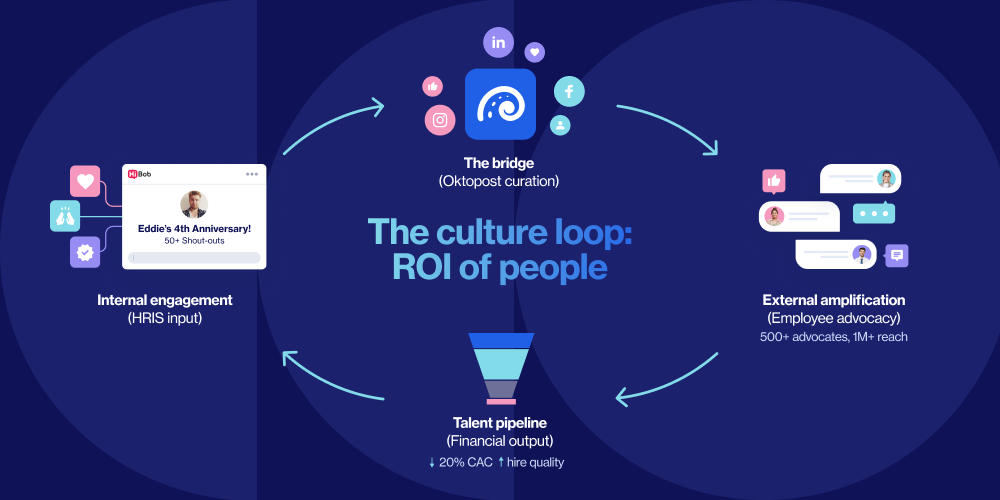
Table of contents
Engagement scores are up. Culture initiatives are well-funded. And yet, hiring is getting harder and more expensive.
This is the tension many HR leaders are already absorbing in their hiring budgets. Despite record investment in employee experience, cost-per-hire continues to rise. Time-to-fill stretches longer. Employer brand struggles to influence candidates early in the process.
The problem is not your culture. It’s where that culture lives. This is why employee advocacy for HR becomes a strategic lever, not a nice-to-have.
Why a strong culture is still failing your hiring goals
You’ve done the heavy lifting. You’ve built a genuinely people-first environment, your internal communications are thriving, and engagement scores reflect it. Perhaps you’re even using a sophisticated platform like HiBob to manage and nurture your internal culture.
But here’s the paradox: while your culture is strong on the inside, it remains invisible where candidates are making decisions.
The problem? Your culture is trapped behind a digital “glass wall” inside internal systems. Your biggest differentiator never reaches the market. Over time, the longer it stays hidden, the more it drives up hiring costs and weakens your ability to compete for talent.
It also leaves HR teams explaining rising recruitment spend to finance leaders who expect culture investments to show measurable returns.
The limitation of the internal-only strategy
Modern HRIS and engagement tools are brilliant at fostering a sense of belonging within the four walls of your company, or the digital equivalent. In practice, they provide the digital home for human capital. However, these tools are, by design, internal systems. When an employee hits a major milestone or a team completes a groundbreaking project, that win stays inside.
Meanwhile, candidates aren’t browsing your internal feeds. They are on LinkedIn, industry forums, and social communities. From their perspective, your people-first culture sounds like corporate silence.
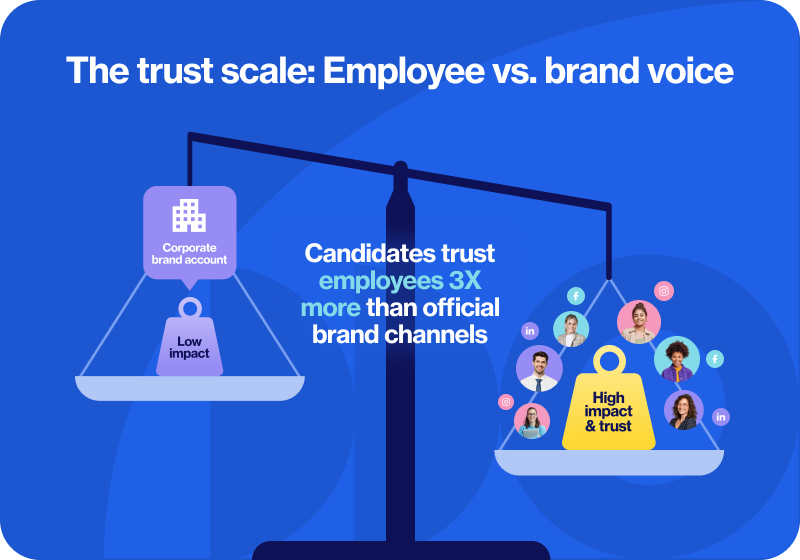
This creates a strategic gap: when your culture is locked away, you are forced to rely on expensive, branded recruitment ads. But in 2026, candidates don’t trust brands. They trust people. And if your people aren’t visible, your competitors’ people are.
The 3 psychological barriers to employee advocacy for HR
If the solution is “get employees to share,” why is it so hard? Most HR managers run into three specific hurdles:
- The corporate mouthpiece fear: Employees are protective of their professional brands. If you ask them to share generic, marketing-approved job descriptions, they’ll resist. They don’t want to look like they’re being forced to sell.
- The friction point: Even the most engaged employee won’t advocate if it’s difficult. If they have to download an image, write a caption from scratch, and remember the right hashtags, advocacy becomes a chore that stays at the bottom of the to-do list.
- The what’s in it for me factor: Employees often don’t see how sharing company news helps their career. Without a way to show them the impact of their voice, motivation fades quickly.
Recommended for further reading
Bridging the gap: Moving from “milestones” to “market presence”
The goal isn’t to create more work for your team. Instead, it’s to turn existing internal engagement into external brand equity. By doing so, and bridging the gap between your internal system of record, like HiBob, and an external social advocacy platform such as Oktopost’s Employee Advocacy solution, you create a seamless flow of authentic content. As a result, employee advocacy for HR is a measurable way to influence hiring costs, employer brand credibility, and retention. When a milestone happens internally, Oktopost provides the infrastructure to make it share-ready in one click.
This shift moves your strategy from internal comms to social sourcing:
- Authenticity at scale: You move from one polished brand voice to hundreds of unique, authentic employee voices.
- The referral engine: Every time an employee shares, they are effectively pre-vetting your company to their personal network, the most fertile ground for high-quality, low-cost hires.
- Quantifiable ROI: You stop defending culture as a cost center and start proving it as a hiring and retention lever. You can track exactly how many applicants and hires originated from employee-shared stories.
Signs this is already costing you
If any of the following sound familiar, your culture is likely strong internally. But it may be underperforming in the market:
- Cost-per-hire is rising year over year, even as engagement and well-being scores improve
- Recruitment teams rely heavily on paid ads, agencies, or referrals with limited reach
- Time-to-fill continues to stretch for critical roles
- Employer brand initiatives struggle to show measurable impact beyond awareness
- High-quality candidates arrive late in the funnel, already influenced by competitors
- HR is asked to justify culture and EVP investment under increased CFO scrutiny
These are not signs of a weak culture. They are signs of a strong culture that isn’t visible where hiring decisions are made.
Advocacy as a retention tool
There is a secondary, often overlooked benefit to externalizing your culture: retention.
In fact, research shows that employees who actively advocate for their company are significantly more engaged and less likely to leave. Why? Because the act of publicly sharing a company win reinforces their own sense of pride and belonging.
They aren’t just working there. Instead, they are building their professional legacy alongside yours. Want to see how modern HR leaders are putting employee advocacy for HR into practice? Watch the webinar on building a strong EVP with LinkedIn and HiBob.
The cost of keeping culture invisible
In the 2026 talent market, your culture shouldn’t be a secret. It should be your most powerful, measurable, and vocal competitive advantage. Employee advocacy for HR is what turns internal culture investment into visible, defensible business impact.
Over the next 12–18 months, the gap between companies with visible employee voices and those without will widen. When employee voices stay silent externally, hiring relies more on paid channels. Employer brand also loses credibility.
Ultimately, the organizations that will win are not the ones investing more in culture alone. They are the ones turning that culture into visible, trusted proof in the market through their people. In reality, your culture is already one of your strongest assets. The risk is continuing to treat it as an internal benefit instead of a market advantage.