



- Roughly 66% of legal clients research a lawyer online before ever reaching out, so a partner's visibility shapes the decision before it's made.
- Consistent posting from partners builds trust before the first conversation, effectively warming up leads before a formal pitch.
- Overcoming objections (time, risk, relevance, ROI) requires marketing support: templates, approval workflows, and AI-assisted drafting.
- Platforms with compliance checks and analytics let firms track partner-level engagement and tie it to real business development outcomes.
Quick wins (TL;DR)
- Clients research partners long before the first meeting. In fact, about 66% of legal clients do online research before ever hiring a lawyer. Your partners’ LinkedIn profiles and thought-leadership content are being scrutinized by prospects in advance.
- Executive visibility shapes how clients perceive expertise. 75% of B2B decision-makers say a company’s thought leadership (like articles or posts from its experts) is more trustworthy for assessing capabilities than traditional marketing. A silent online presence can make a firm seem outdated, whereas active thought leaders signal credibility.
- Consistent posting from partners strengthens trust and credibility. Showing up regularly with valuable insights signals you’re an engaged, reliable professional. Consistency keeps you visible and reinforces your brand, preventing you from being forgotten in a crowded feed.
- Executive advocacy accelerates business development by keeping your firm top of mind. By consistently sharing expertise, partners build trust before the first conversation and stay on potential clients’ radar. When a need arises, those prospects will think of your firm first.
- Marketing can make participation simple with workflows, content packs, and approvals. With the proper support, partners only need minutes to participate. Provide pre-approved content templates and a clear approval process to make posting quick and risk-free.
- Tools like Oktopost make executive advocacy measurable, safe, and scalable. Modern employee advocacy platforms include compliance checks and approval workflows to keep posts on-brand, as well as analytics dashboards to track engagement and ROI from partners’ social media activity. This means you can expand your program confidently and prove its value.
Partners sharing insights on LinkedIn can create familiarity with prospects well before a formal pitch.
Imagine a partner posts a short insight on LinkedIn. A prospective client sees it and follows that partner for a few weeks, engaging with a few posts. Eventually, the prospect reaches out directly. By the time the first meeting happens, the conversation is warm because trust has already been established online. The relationship began before the pitch. This scenario – a client engaging with a partner’s thought leadership before an introduction – demonstrates the power of executive advocacy for law firms.
Why partner visibility now shapes firm reputation
For clients, expertise is no longer judged only by past cases or firm rankings – it’s judged by accessibility and visibility. When partners share their thinking online, clients get a window into how they interpret issues in real time and gain confidence in their perspective. An active, professional presence on social media conveys credibility, authority, and responsiveness, whereas a lack of presence can send the opposite message. Silent leaders unintentionally suggest that the firm is behind the times or disconnected from clients. In contrast, partners who show up consistently signal that they understand the industry, care about clients’ challenges, and are comfortable being the face of the firm. Remember, an outdated or bare profile can make a firm seem inactive or disconnected from its audience. Visibility shapes perception – and in the digital age, perception quickly shapes reputation.
The impact of executive advocacy on business development
When partners build a presence on platforms like LinkedIn, they expand their influence far beyond their rolodex. Executive advocacy becomes a business development engine because it:
Builds trust before the first conversation
Clients often feel they already know a partner before ever speaking with them. By the time a formal introduction happens, the prospect has seen the partner’s expertise and viewpoints on display. Thoughtful social media content essentially “warms up” the lead by establishing credibility in advance. In high-trust fields like law, this early credibility makes it far more likely someone will reach out when they need help.
Keeps the firm top of mind
Regular posting ensures your partners stay visible between meetings, pitches, and events. In a world of information overload, consistency is what ensures you remain on your audience’s radar. Maintaining a steady flow of content means clients won’t forget about you – you stay top of mind for when a legal need arises. Even if a connection isn’t ready to hire you today, your ongoing insights mean that when they are ready, your firm is the first they think of.
Creates relationships at scale.
Instead of relying solely on one-to-one lunches or networking events, partners can engage thousands of potential clients and referral sources simultaneously through social media. A single LinkedIn post or comment can reach countless industry contacts. Over time, these small interactions – a quick comment here, a shared article there – accumulate powerful relationship equity. This digital networking is highly efficient: attorneys can research, prospect, and demonstrate expertise to many prospects at once, far beyond their immediate circle.
What strong executive advocacy looks like
Strong executive advocacy blends expertise, clarity, and personality. Importantly, partners do not need to become “influencers” or viral content machines – they simply need to consistently and authentically show up with value. Here are some best practices:
Practical posting formula:
To keep participation easy, use a simple formula for posts each week: For example,
- one short insight on a current legal or industry trend,
- one reflection or lesson from recent client work (no confidential details, of course), and
- one engagement activity (such as commenting on a colleague’s post or answering a question).
This framework ensures a steady mix of content without much guesswork. Even a modest goal like one original post per week can be effective when done consistently.
Defined content pillars:
Help each partner identify 3–5 content pillars to focus on. These might include
- industry trends,
- regulatory updates,
- case-law insights and learnings,
- leadership and people-development stories, and event takeaways.
Content pillars keep their messaging focused and on-brand – every post aligns with an area where the partner wants to be known as an expert. Having set themes also makes it easier to brainstorm ideas that reinforce the firm’s positioning.
Balancing authority with approachability: Clients want lawyers who are both highly knowledgeable and human. An authoritative voice doesn’t mean a stuffy one. It’s okay (and even beneficial) to use a conversational tone or share personal observations alongside technical insights – this makes the content more relatable without diluting credibility. In fact, an executive’s social media presence can humanize the firm, making leadership appear more approachable, honest, and trustworthy. The goal is to let the partner’s personality shine professionally.
Showcasing real expertise: Don’t be afraid to get specific. Short explanations, quick “how-to” breakdowns, and real examples are pure gold – they reveal how a partner thinks and problem-solves. Breaking down a complex legal development into plain English, for instance, demonstrates the partner’s expertise in a way clients can appreciate.
This kind of content shows how you approach challenges, not just that you have credentials. That insight into a partner’s thought process is what clients value most; it builds confidence that “this lawyer really knows their stuff.”
Overcoming common objections from partners
It’s normal for some partners to resist jumping into executive advocacy. Most pushback falls into four predictable categories, which you can tackle with the right approach:
Time: “I’m too busy to post on LinkedIn.” In reality, partners do not need hours of spare time to participate. Marketing can make it almost turnkey – use content drafts, templates, or even ghostwriters so that posting and engaging only takes a few minutes a week. With a workflow of short input sessions (even voice notes) and marketing handling, editing/approval, the time commitment can be as little as 15 minutes per week.
Risk: “What if I say the wrong thing?” It’s a valid concern in a legal context, but it’s addressable. By establishing clear social media guidelines and a simple internal approval process, partners can share insights safely without fear of compliance issues. Every post can go through a quick review to ensure it meets firm and ethical standards. Employee advocacy platforms even have built-in compliance checks and approval workflows to catch any issues before anything goes live. In short, with the proper safeguards, the risk is minimal.
Relevance: “Does my practice really have an audience on social media?” Absolutely. Every practice area has clients (and referral sources) who are hungry for information. Whether it’s employment law, tax, IP, or litigation, there are business owners, in-house counsel, and professionals out there looking for voices that speak their language. Remember that 57% of in-house counsel consider LinkedIn a valuable source of professional content – even niche specialists can find their audience online. The key is to share content that addresses the specific concerns and terminology of your practice so it resonates with the right people.
Perceived lack of ROI: “Is posting on social really going to bring in business?” Partners who are skeptical of the return often change their tune once they see the impact firsthand. Executive advocacy drives visibility that translates into pipeline – it’s essentially a form of social selling. For example, 95% of B2B decision-makers say that strong thought leadership content (the kind executives share) makes them more receptive to a firm’s outreach. Consistently visible partners become trusted names, which leads to more inquiries and referrals over time. The ROI becomes clear as partners start to see prospects mentioning their posts in conversations and new leads coming in who “feel like they already know them.” It’s a long game, but one with compounding returns on reputation and revenue.
How marketing and BD teams can enable executive advocacy
Our lawyers will succeed on social media when they have structure and support behind them. The firm’s marketing and business development teams play a crucial enabling role. Here’s how they can make executive advocacy easy and effective:
Content workflows & templates: Provide partners with ready-to-share posts, content “packs,” or simple talking-point outlines so they never start from scratch. Marketing can plan topics aligned with the firm’s campaigns and even draft posts based on a partner’s brief notes. By doing the heavy lifting on content creation (while preserving the partner’s voice), you remove a huge barrier. It’s much easier for a busy attorney to review or tweak a drafted post than to write from a blank page.
Executive branding sessions: Sit down with each participating partner to define their personal brand on social.
- What key themes do they want to own?
- What tone and style suits them?
A short training or brainstorming session can help clarify each executive’s content pillars and comfort zone. Essentially, marketers act as coaches to help partners discover their voice and map out topics where they can shine. This upfront investment makes ongoing content creation more cohesive and on-message.
AI-supported drafting and editing: Take advantage of AI tools to accelerate the writing process in a way that still sounds like the partner. For example, some advocacy platforms allow you to generate a draft post from a few bullet points or from an article URL. Marketing can use these tools to create quick first drafts, which the partner can then personalize. AI won’t replace the attorney’s insight, but it can transform raw ideas or notes into polished, shareable posts faster. This means even less time required from partners to maintain a steady flow of content.
Centralized compliance review: To keep everyone confident, run all proposed social posts through a brief internal review. Marketing (or a designated compliance officer) should check that nothing in the content violates confidentiality, ethics rules, or firm policy before it’s posted. A central approval queue in your advocacy tool makes this seamless. With a safety net in place, partners can be assured that their online activity won’t cause issues – the firm is watching their back. Additionally, track each partner’s post performance (engagement, impressions, and generated leads) and share those metrics. By monitoring what works, you can refine the strategy and also show partners the tangible impact of their efforts.
By providing this kind of structure – from content planning and ghostwriting, to scheduling and compliance – the marketing/BD team lets partners focus on sharing their expertise without logistical headaches. It turns executive advocacy into a supported team effort rather than a solo chore for lawyers.
Why executive advocacy matters more in legal services
In professional services, the firm is its people. Clients don’t hire a logo; they hire the lawyers behind the logo. In fact, it’s often said that clients hire lawyers, not law firms– and they tend to hire those lawyers they know, like, and trust. Trust and credibility carry tremendous weight in the legal industry (even more than in many others) because legal engagements are high-stakes, high-trust decisions. Every interaction or piece of content that a partner puts out can reinforce (or undermine) a client’s trust in their expertise.
Executive advocacy gives clients a window into how your partners think and approach problems. That’s a competitive advantage no glossy brochure or static bio can match. When a GC or CEO regularly sees a partner break down a new regulation or comment on a court ruling, they’re effectively experiencing that lawyer’s thought process and judgment. They begin to view that partner as a go-to authority.
Research has shown that effective thought leadership content can influence buying decisions and even price sensitivity, making decision-makers more willing to seek out your services and pay a premium for your expertise. In short, clients aren’t just buying a service; they’re buying access to the expert mind of the lawyer. Executive visibility allows them to “preview” that mind in action.
By embracing executive advocacy, law firms let their experts’ reputations amplify the firm’s reputation. It’s an edge in credibility and relatability that is especially critical in law, where personal trust is the currency of business. As a result, the firms that encourage their partners to be visible and engaged will attract clients who gravitate toward experts they can see, hear, and learn from regularly.
How Oktopost supports law firm advocacy programs
Running a successful executive advocacy program at scale can be challenging – but social media management tools like Oktopost are built to make it easier, safer, and measurable for law firms. Here are a few ways Oktopost can bolster your initiative:
Executive account management: Oktopost provides a centralized platform that lets marketing manage content distribution across multiple partners’ accounts without hassle. Partners don’t need to log into separate accounts or juggle extra steps – approved content can be queued up and shared on their behalf (with their permission), saving time and ensuring consistency. This “single hub” approach streamlines participation for busy attorneys.
Content suggestions and libraries: The platform can offer personalized content suggestions based on practice areas, post tagging, or trending industry topics. This helps partners know what they can post. Marketers can curate a library of firm-approved articles, insights, or updates that partners can easily pick from to share. This means even those who aren’t sure what to say will have a steady supply of relevant material at their fingertips.
Safe approval workflows: Oktopost enables a clear approval workflow for all posts. Before anything goes live, content can be seen by the necessary reviewers (marketing, compliance, etc.) within the tool. This ensures every post update by a partner has been vetted for compliance and messaging. The result is peace of mind – partners can post with confidence, knowing each item complies with firm policies and ethical standards.
Analytics for partner-level influence: Robust analytics dashboards let you track the reach and engagement of each executive’s posts, so you can actually measure who is driving impact. You’ll see metrics like clicks, comments, shares, and even lead conversions attributed to individual partners. By pushing social activity data into your CRM, you can tie a new client inquiry or opportunity to a specific partner’s post, providing concrete ROI insights. These insights help demonstrate the business development value of executive advocacy (and can motivate more partners to get on board).
Advocacy integration with firm channels: Oktopost lets you coordinate content across the firm’s official social media and partners’ personal sharing. For example, a thought leadership blog post on the firm page can be seamlessly distributed to all participating partners for one-click sharing, massively amplifying its reach. This integration means your corporate content and your executives’ voices work in harmony, boosting overall visibility and reinforcing the firm’s thought leadership message from multiple angles. In short, Oktopost is designed to make executive advocacy structured, scalable, and secure.
Using Oktopost, your social team can take care of scheduling, compliance, and tracking – so that your lawyers can focus on delivering insights. The platform’s features, such as content libraries, automated scheduling, approval workflows, and a unified analytics dashboard, provide the infrastructure needed to roll out an advocacy program across dozens of partners efficiently.
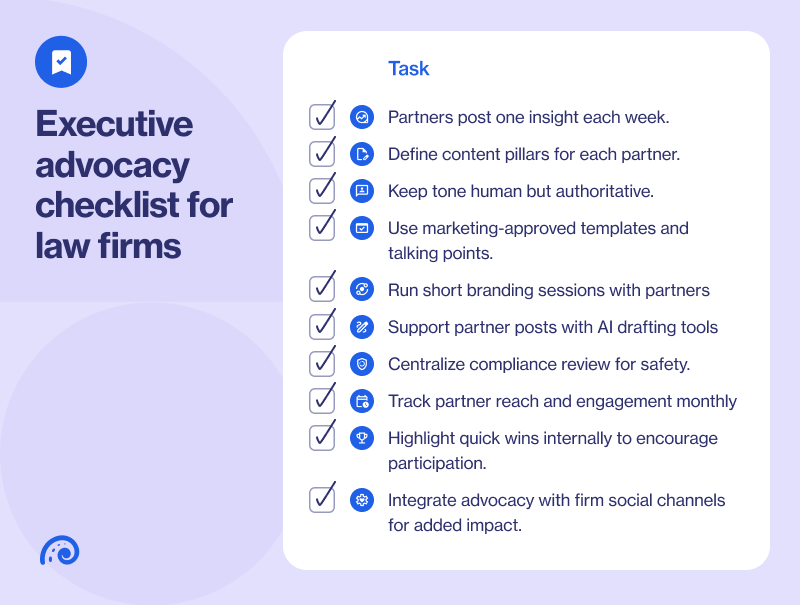
Executive advocacy checklist for law firms
Finally, here’s a quick checklist to make sure your executive advocacy program covers all the bases:
- Have partners post one insight each week. Being consistent matters – a regular cadence (e.g., weekly) keeps partners visible without overwhelming them.
- Define content pillars for each partner. Identify the core themes each partner will focus on to maintain a coherent message and play to their strengths.
- Keep the tone human but authoritative. Posts should sound like a knowledgeable person, not a press release – encourage a balance of professionalism and personality.
- Use marketing-approved templates and talking points. Provide pre-made post templates or bullet points so partners aren’t starting from zero each time (and to ensure quality control).
- Run short branding sessions with partners. Invest time in coaching partners on their online persona and content strategy – this upfront work pays off in more authentic content.
- Support partner posts with AI drafting tools. Leverage AI to help generate or polish content quickly, making it easier for partners to create posts that still feel like “them.”
- Centralize compliance review for safety. All posts should go through a quick central review to catch any issues – this gives partners confidence to speak freely within guidelines.
- Track partner reach and engagement monthly. Monitor metrics for each partner (views, likes, comments, leads) and share the wins to illustrate progress and refine the approach.
- Highlight quick wins internally to encourage participation. Share success stories (like a post that led to a new client inquiry) with the firm – it will motivate others to get involved.
- Integrate advocacy with firm social channels for added impact. Coordinate between the firm’s official content and partners’ sharing – amplify important firm posts through your executives’ networks.
By following this checklist, your firm can build an executive advocacy program that not only enhances individual partner brands but also strengthens the firm’s overall reputation and reach.
Final thought: visibility wins clients
Executive visibility on social is not optional – it’s a fundamental part of shaping your firm’s reputation in a connected world. When law firm leaders step forward on social media with genuine insights, they build trust, humanize the firm, and keep the organization at the forefront of clients’ minds.
Over time, that trust and familiarity translate directly into business development advantages. The firms that embrace executive advocacy are gaining a meaningful competitive edge because clients naturally gravitate toward experts they can see, hear, and learn from regularly. In the end, empowering your partners to be thought leaders isn’t just a marketing tactic – it’s an investment in credibility that pays dividends in client relationships and growth.
Sources:
- The 2024 Edelman–LinkedIn B2B Thought Leadership Impact Report (via JD Supra)
- Greentarget/Zeughauser Group’s 2022–2025 State of Digital & Content Marketing reports (as highlighted by Jaffe PR and O’Dwyer’s)
- Legal marketing guides such as LawRank’s Social Media for Lawyers and employee advocacy best practices from platforms like Oktopost and industry experts – NP Strategy