

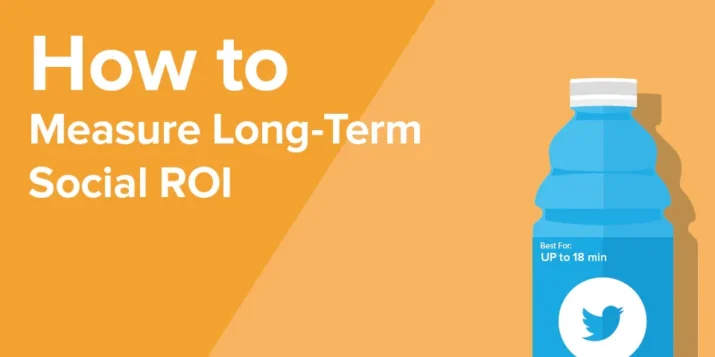
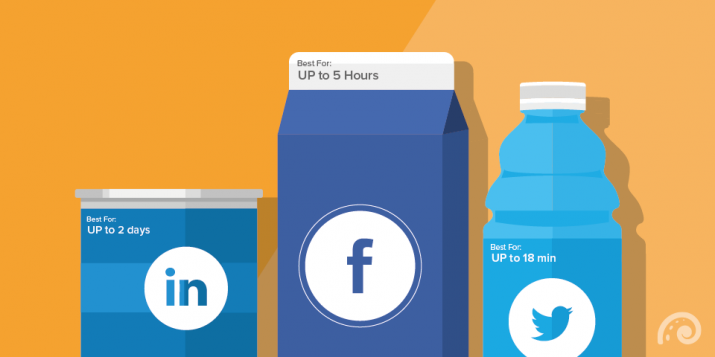
Social media is founded on the principle of instant, temporary dissemination. While it’s possible to dig through the archives to use social posts as a record of the past, it’s not common, and each post has an incredibly short shelf life. Facebook posts average 2–5 hours, Tweets live approximately 18 minutes, and LinkedIn usefulness expires after about 2 days.
This constant revolution of posts going through our feeds also often translates to the measurable ROI of social media. Many companies like to track the ROI of the short term. While it’s important and instantly gratifying to see the reach and engagement generated through social channels, there needs to be a shift toward calculating the ROI of social media in the long term. Doing this will tell marketers more about their efforts in the customer lifecycle.
It’s important to firstly understand the measures of short-term ROI so you can move beyond it using long-term tactics.
Building on the short term
Short-term social media ROI examines the immediate aftermath of publishing a post. The considered factors include engagement, views, clicks, shares, and, ultimately, conversions. A marketing automation platform (MAP) that measures all of these immediate interactions gives a short-term view of how successful your social efforts are. The dashboard provides an overview of this information with deep dives into what is more significant to your company.
A MAP conversion tracking feature is especially powerful in elucidating how effective social media has been at bringing customers to your products and services. This feature shows how social media impacts the sales funnel and which messages are driving your acquisitions.
These short-term metrics drive business results, prove ROI for keeping your social media management platforms, and provide evidence for investing further in social strategy. To move beyond this limited view, it’s crucial to look deeper at the long-term effects of using and measuring social media.
Formula for long term
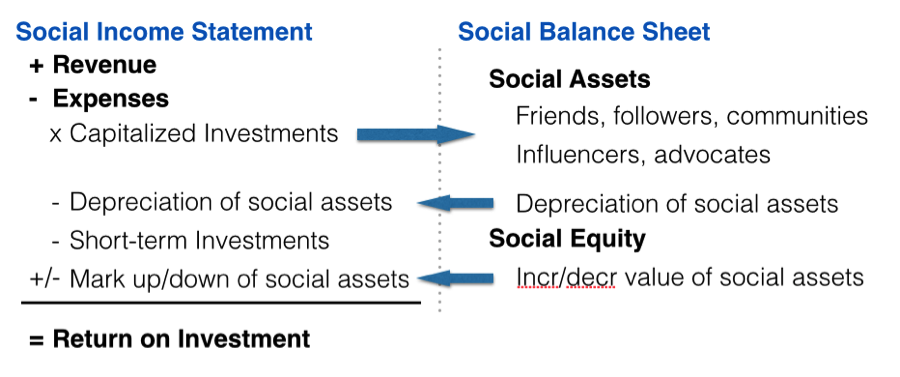
Dave Hanley, principal at Deloitte Digital, says marketers should be measuring social media ROI in the long term. In order to do so, it’s necessary to look at the value of certain assets over time. These assets include fans, followers, brand ambassadors, influencers, and other elements that have been active and tracked for more than three months.
Below you can see the social media ROI model that Hanley came up with:
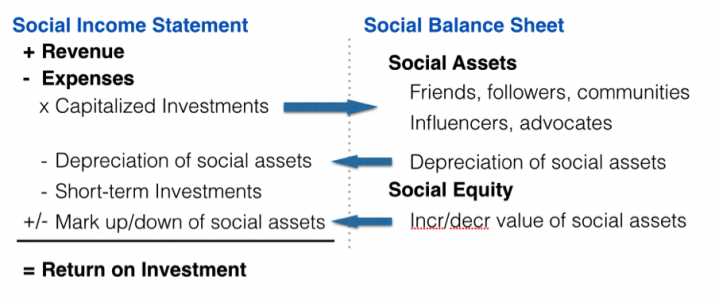
Determining the value of these assets involves measuring the sum of financial impact, the impressions, and engagement, which is not otherwise possible with traditional media. A conversion tracker is especially helpful in these situations because it can measure how a follower became a customer where applicable. It’s critical to also consider the initial financial investment of any social media management tools, workforce, and technology.
More importantly, you need to factor in the possible depreciation of value. Social media often acts like a shiny new toy that companies and individuals can lose interest in after a solid first run. The key is to keep up with followers by cultivating engaging conversations and providing worthwhile content. Then, the long-term ROI speaks for itself.
Social media has evolved since its inception as a networking and communication tool. It is now a proven business tool for generating leads and is an essential piece of the sales funnel and customer lifecycle. However, many marketers are still only measuring the short-term ROI of their social efforts. With a shift towards long-term customer relationships and a real attempt at sustaining the effectiveness of social media, the ROI will increase for years to come.