



Back in 2011, Gartner predicted that by 2020, customers would manage 85% of their relationship with the enterprise without human interaction. It’s 2016, and their vision already seems accurate.
In a world where computing is becoming increasingly ubiquitous, the power is in the hands of the buyers. They can conduct their research and set their own terms, which completely redefine the sales funnel.
Despite a nine-year warning from Gartner, many CMOs remain incredibly unprepared to communicate with their customers in the digital age.
The traditional sales funnel
In the traditional sales funnel, prospects would go through the standard stages of awareness, interest, decision, and action. They would enter the funnel through a direct mail campaign, a cold call or some other outbound method, followed by an interaction with the sales rep who would walk them through the entire process.
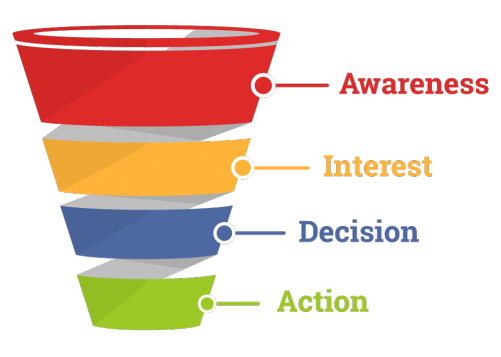
This single point of communication facilitated a seamless transition from lead to prospect, and ultimately to a customer. With very limited engagement channels available, sales reps could easily control the message and carefully tailor it to each of their prospects. And if prospects needed any additional information regarding the company, product or service, they would have to get in touch with the sales rep.
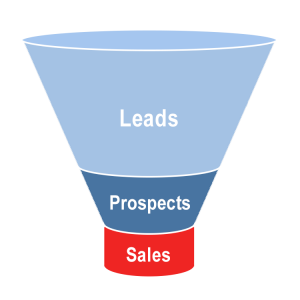
Today’s consumers are disrupting that cycle
Digital marketing and marketing automation have completely disrupted the traditional funnel. Nowadays, prospects have various ways to gather information about a company through social media, online reviews, industry blogs, and other media. They are also communicating with the company via email, social, podcasts, live chats, and the list goes on.
It should come as no surprise, then, that 67% of the typical B2B buyer’s journey is done digitally. In fact, 9 out of 10 B2B buyers say online content has a moderate to major effect on their purchasing decisions.
This change presents new challenges for B2B companies, which typically enjoyed a very straightforward sales funnel. It’s essential to recognize that prospects must still progress through the traditional stages of awareness, interest, desire, and action; the only difference lies in their role in that process.
The symbiotic relationship between marketing and sales
With so many communication channels, touchpoints, and pieces of information involved in the new sales funnel, it becomes impossible for a single sales representative to maintain control over the entire process.
Selling is no longer a one-man job, but rather a mission for an entire company, meaning everyone needs to be on the same page when it comes to message and approach. The content created by social media teams needs to align with the message delivered through email marketing. Which, in turn, needs to coincide with the sales rep’s positioning.
According to Ascend2’s 2016 “Marketing Automation Trends Survey,” 30% of respondents say marketing-sales alignment is one of the most significant barriers to marketing automation success. Being able to nurture a prospect through carefully automated emails and social media is a vital part of lead generation. Unfortunately, if those messages don’t support the in-person sales interactions, the entire sale will fall apart.
[Tweet “67% of the typical B2B buyer’s journey is done digitally. Here’s how you can engage in the new sales funnel.”]
How marketing automation can support and nurture the sales cycle
Firstly, the ways in which marketing engages and nurtures prospects in the sales funnel need to be revised. Many CMOs view marketing automation as merely a time-saving tool. However, marketing automation enables the customization of communication in a way that delivers the right message to every prospect at the right time. This makes it ideal for supporting the sales cycle.
Ascend2 also found that the most important strategic goals of a marketing automation strategy are:
- Increasing lead generation (61%)
- Lead nurturing (57%)
- Sales revenue (47%)
While a single sales rep may not be able to adapt to the multi-channel interaction of today’s sales funnel, a well-designed marketing automation platform absolutely can. Companies using marketing automation to engage their audience are:
- 60% more likely to regularly repurpose content
- 2 times more likely to capture intelligence for the sales team
- 230% more likely to customize content to the Buyer Journey stages
- 5 times more likely to use intelligent targeting to trigger content
Marketing automation offers sales and marketing departments key insights into how their audience is behaving online. These insights can make a big difference in content creation. Tailoring social media, email, and blog content to individual prospects as they progress through the sales funnel will help produce a qualified lead for sales.
The tools needed to engage in the new sales funnel
Even with marketing automation, sales representatives cannot simply sit back and let marketing present them with prospects that are already further down the sales funnel. They need to ensure they are plugged into every aspect of the sales funnel. Emails sent through marketing automation, social media content, and the broader lead generation messages should all come directly from the sales representative.
Despite the fact that 84% of C-level and vice president executives use social media to support purchase decisions, sales reps are extremely under-supported in their use of social selling. Most reps that use social media lack formal training and company-wide tools to fuel their efforts. This prevents them from integrating with other marketing automation campaigns being run by the marketing team. In fact, only 8.5% of social selling users have a program that is fully integrated into the sales process.
Despite this lack of integration, social sellers report a 63.4% annual increase in their company’s sales revenue, compared to 41.2% for non-social sellers. With a fully integrated social selling campaign that supports and draws upon the overall marketing automation plan, sales representatives will experience greater success.
Engaging with customers in the new sales funnel is no easy task. Although there are varied opportunities for engagement, effectively capitalizing on those opportunities is much more difficult. Sales and marketing teams need to collaborate by utilizing tools such as marketing automation and social media management if they expect to create a seamless and unified sales experience for their prospects.
How do you utilize marketing automation for the new sales cycle? Share your experiences in the comments below!