


B2B marketing teams often grapple with a pressing question: “How do I get my employees to be active on LinkedIn and share our company content?” This guide tackles that challenge head-on. In B2B marketing, LinkedIn is a powerhouse platform – 4 out of 5 LinkedIn members influence business decisions, yet many companies find that their own employees are silent online.
Disengaged employees who aren’t amplifying the brand represent untapped potential. By activating these employees as brand advocates, organizations can dramatically expand their social reach, strengthen credibility, and create a win-win scenario for both the brand and the individual.
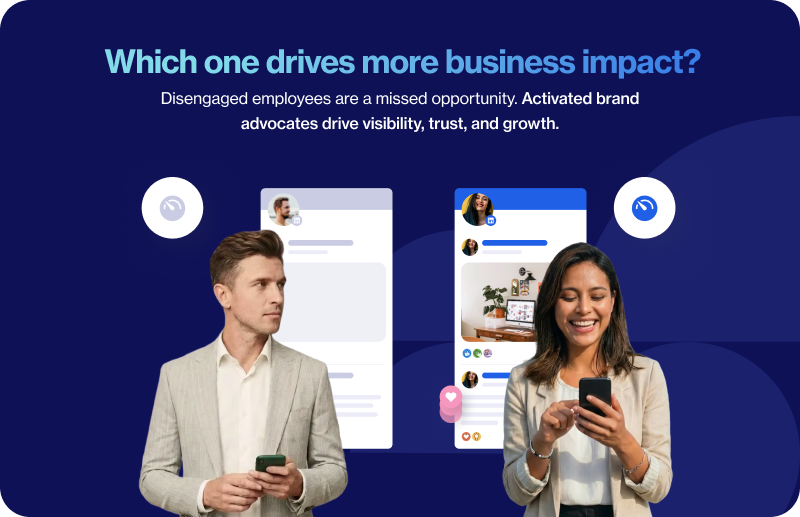
Why are disengaged employees a missed brand advocacy opportunity
Many B2B companies find that while their employees are on LinkedIn, they aren’t actively posting or sharing company content. This disengagement is a widespread issue – in fact, 74% of social media managers say their top challenge is getting employees to participate in advocacy. The symptoms are clear: corporate posts have meager reach with few employee reshares, and only the marketing team (or a handful of enthusiasts) ever talks about the brand online. Employees who remain silent on social media are missing a huge opportunity. Instead of functioning as proud brand ambassadors, these team members are essentially invisible in the social arena.
Why does this matter? Because in B2B marketing, every employee’s voice can significantly amplify the brand’s message. When employees don’t engage:
- The company’s social reach stays limited to official pages and ads.
- Trust and authenticity are harder to establish (people trust people more than logos).
- Valuable connections (potential clients or talent in employees’ networks) aren’t being reached or influenced.
To illustrate the problem, imagine a 500-person company where only the social media manager shares updates. That’s 1 person speaking for 500, while 499 remain disengaged. The pain points voiced by many marketing leaders reflect this scenario: “How do I get my employees active on LinkedIn? How do I encourage them to share our content?”The lack of employee participation is not due to ill intent; it often stems from uncertainty or a lack of incentives, resulting in a one-sided social media presence. In sum, the problem is clear: disengaged employees mean the company isn’t fully leveraging its greatest marketing asset – its people.
The business impact of low employee advocacy in B2B marketing
Disengaged employees on social media don’t just “fail to amplify” content – they impact the business in multiple ways. Here’s how insufficient employee advocacy affects key areas of B2B marketing and sales, contrasted with the benefits when an advocacy program is thriving:
- Limited reach and visibility: Company social posts have limited reach and visibility. Without employees sharing, your content only reaches your corporate followers. By contrast, when employees share, the difference is monumental: employees’ collective networks are, on average,10× larger than the company’s follower count. In fact, brand messages shared by employees achieve 561% more reach than when shared via official channels. Without advocacy, you’re leaving that massive reach untapped.
- Lower trust and credibility: Prospects trust people over corporate communications. Without employees’ voices, you rely solely on brand messaging, which audiences may view skeptically. 76% of people are more likely to trust content shared by individuals (employees) over content from official brand channels. When employees advocate for the brand, it gains authenticity and credibility in customers’ eyes.
- Missed engagement and leads: Disengaged employees mean fewer likes, comments, and shares on your content, leading to fewer conversations and fewer leads. Content shared by employees can generate 8× higher engagement than content shared by the company page. More engagement often translates to more website traffic and lead opportunities. Without that boost, marketing ROI on social content suffers.
- Stunted social selling & sales impact: For sales and customer-facing teams, a lack of social activity results in missed sales opportunities. Socially active sellers create more pipeline – LinkedIn data shows sales professionals who leverage social media have a significant edge, including being 51% more likely to hit quota. Without employees building relationships and credibility online, your organization misses out on warm leads and introductions that drive revenue.
- Weaker thought leadership and brand awareness: When employees aren’t posting, your brand misses opportunities to join diverse conversations. Active employee advocates help position your company and its experts as thought leaders (e.g., through sharing industry insights or publishing posts). Without them, brand visibility and thought leadership rely only on official channels, which are easier for audiences to tune out. Remember, 91% of B2B sales are influenced by word of mouth, and employees often spark valuable peer discussions.
- Reduced employee engagement and development: Ironically, disengaged employees on social media can also indicate lower engagement within the company. If employees don’t feel connected enough to share successes or content, they may feel less connected to the company’s mission. On the flip side, a strong advocacy program boosts internal morale: employees who participate often develop new skills and feel greater pride. 86% of employees in an advocacy program say it positively impacted their career, expanding their networks and personal brands. Without this outlet, employees miss opportunities to build their personal brands (becoming known as experts in their field), and the company misses an employee development tool.
- Talent attraction and employer brand: When employees don’t talk about the company, there are fewer authentic glimpses of your culture on social media. Potential recruits do check LinkedIn and other networks – 75% of job seekers consider an employer’s brand before applying. If they don’t see or hear from your employees, your company may appear less attractive. In contrast, a workforce that openly shares and celebrates the company story can attract talent (for instance, job posts shared by employees get 30% more applicants).
The bottom line: a disengaged workforce on social media costs your business in visibility, trust, leads, sales, and even hiring. Conversely, activated employee advocates can be a game-changer. To visualize the stark difference, consider the following comparison of outcomes with and without an employee advocacy program:
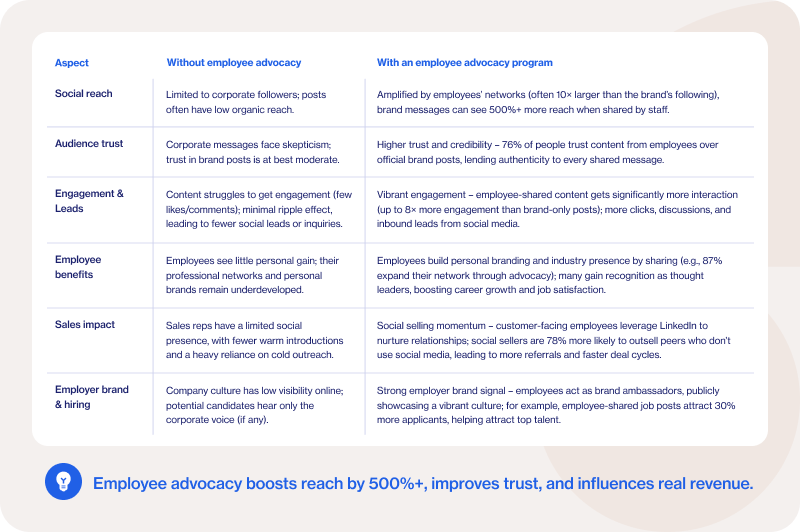
As the table shows, the contrast is significant. Without advocacy, your reach, engagement, and credibility are constrained. With an active program, the organization can tap into exponential reach, greater trust, and numerous downstream benefits (from leads to talent acquisition), while employees advance their professional profiles. In short, solving this problem creates a win-win scenario – the organization gains marketing and sales advantages, and employees gain influence and opportunities.
Common reasons employees don’t share company content on LinkedIn
Before we can activate disengaged employees, we need to understand why they aren’t engaging in the first place. It’s rarely because employees don’t care about the company – more often, specific barriers or misconceptions are at play. Here are the key root causes that prevent employees from being active brand advocates:
- Lack of confidence or fear of posting: For many professionals outside the marketing department, posting on LinkedIn or X can feel daunting. They might worry their content isn’t good enough or fear saying the wrong thing in a public forum. This hesitation is common – employees may think “I’m not a social media person” or worry about bothering their network. Without guidance or prior experience, posting feels risky. Insight: A clear social media policy and some training can address this by providing employees with do’s/don’ts and reassuring them that it’s “safe” to share. When employees feel supported and know the rules, posting stops feeling intimidating.
- “No Time” and competing priorities: Employees across departments have full plates. If engaging on social isn’t part of their job description, it falls to the bottom of the list. They might intend to share an article later, but “later” never comes amid pressing tasks. In their mind, posting company content is extra work with unclear reward. If advocacy feels time-consuming or difficult, it will always lose out to core job duties. Insight: Making sharing quick and convenient is crucial – for example, using tools that reduce posting to a few clicks and offering pre-crafted posts. When advocacy is easy and fits naturally into the day, employees are more likely to do it.
- Low personal motivation (What’s in it for me?): Even if employees understand that advocacy helps the company, they may not see personal benefits. Without a clear answer to “Why should Ibother posting?”, participation will seem like a favor to marketing rather than a career-building activity. This is a big blocker – when the value to the individual is unclear, advocacy feels optional and not worth prioritizing. Insight: Tying advocacy to personal growth and success is key. Employees need to realize that by being active on LinkedIn, they can build their own personal brand and professional network (leading to career opportunities, industry recognition, etc.). In fact, 86–94% of employees believe that posting on social media benefits their careers, whether by expanding their networks or showcasing their expertise. Highlighting such benefits and sharing employee success stories (e.g., someone whose post led to a sales lead or a speaking opportunity) can boost motivation.
- Lack of relevant content: One practical reason employees don’t share is that they don’t have content that resonates with them. If the only available posts are generic press releases or product updates that don’t match an employee’s role or interests, they’ll refrain from sharing. Employees don’t want to spam their network with content that feels “off” or overly promotional. In other words, relevance is not a nice-to-have; it’s a requirement. Insight: Employees are far more likely to share content that reflects their own voice and interests. Advocacy programs often stumble when they push one-size-fits-all content. The fix is to personalize the content experience – provide a mix of content (company news, industry articles, helpful insights) and allow employees select what’s relevant to their audience. When employees have content they’re proud of and that aligns with their expertise, sharing becomes natural rather than forced.
- No incentives or recognition (Lack of reinforcement): Human nature 101 – if a behavior isn’t recognized or rewarded, people are less likely to continue it. An employee might share a post; if it gets little engagement and no one internally acknowledges it, they may think, “What’s the point?” Many advocacy efforts fade because employees aren’t seeing feedback or encouragement. Likewise, some might stop because they feel managers don’t notice their contribution. Insight: Reinforcement and reward are critical to sustain advocacy. Friendly competitions, leaderboards, shout-outs in company meetings, or even small rewards (swag, gift cards for top sharers) inject fun and incentive. Gamification can spark some healthy competition and motivate employees to stay active. Just as importantly, consistently recognizing all advocates (not just top performers) and celebrating wins – e.g., highlighting when a post did well or generated a lead – creates a positive feedback loop that keeps everyone engaged.
- Insufficient executive buy-in or example: Culture flows from the top. If executives and managers aren’t on board with employee advocacy, employees receive mixed signals. Perhaps the company hasn’t explicitly encouraged employees to post, or leaders themselves never like/share employee posts. This can breed doubt (“Does my company really want me to do this?”). Indeed, achieving executive buy-in is the second biggest challenge cited by advocacy program managers—insight: When leadership actively supports and even participates in advocacy, employees feel empowered. An official program with leadership endorsement, clear goals, and managers who lead by example (such as a CEO who regularly posts on LinkedIn) goes a long way toward legitimizing and energizing employee advocacy.
By diagnosing these root causes, we can craft solutions to address each one. For instance, lack of confidence is addressed by training and guidelines; better tools and workflows solve lack of time; low motivation is solved by emphasizing personal branding benefits; lack of content is solved by content strategy and curation; lack of incentive is solved by recognition and gamification; and executive hesitance is solved by educating leadership on the ROI (e.g., noting that 31% of high-growth companies have formal advocacy programs – over 2× the rate of average firms). Each root cause has a corresponding strategy, which we will explore in the solution section. But first, it’s important to assess how this disengagement manifests in your own organization.
How to identify disengaged employees in your organization
How do you know if your employees are disengaged as brand advocates? Often, the signs are hiding in plain sight. Here’s what to observe in your organization to gauge the extent of the problem:
- Low employee sharing rates: Look at how many employees have shared a company-related post on LinkedIn (or any social platform) in the last month or quarter. If it’s only a handful out of hundreds, that’s a clear indicator of disengagement. (For example, one analysis found in some companies, as little as ~7% of engineers and ~6% of marketers actively shared content – illustrating that the vast majority stayed silent.) Calculate your own “activation rate.” Is it 5%? 10%? This number is a baseline to improve upon.
- Limited diversity of voices: Check who appears in your brand’s social mentions or who’s creating content. If nearly all content comes from the official corporate account or a small social media team, you have a diversity issue – the broader employee base isn’t contributing. In an engaged culture, you’d see many employees (across departments and seniority levels) posting about product launches, events, or industry commentary.
- Employee network engagement: Scan a few employees’ LinkedIn profiles (especially those in customer-facing roles like sales, CS, or SMEs in your company). Are they posting or engaging (liking/commenting on relevant topics)? If their profiles are essentially dormant or purely private, it indicates untapped advocacy potential. Also, observe if employees are engaging with your official brand posts (e.g., liking the company’s updates). A lack of internal engagement could mean employees aren’t seeing or motivated by the content.
- Feedback from employees: Sometimes the best observation is to ask. Conduct a quick survey or informal poll: “What stops you from sharing work or industry content on social media?”Employees’ answers will likely echo the root causes above (e.g., “I don’t have time,” “I’m not sure what I’m allowed to post,” or “I didn’t know it was encouraged”). These insights confirm the barriers present and can help tailor your approach.
- Social media metrics: If you have an employee advocacy platform or even just track referral traffic, examine those metrics. Few shares per content piece or few trackable visits from employee-shared links indicate that the program (if one exists) is underutilized. Also consider your LinkedIn SSI (Social Selling Index)averages if you’re focused on sales teams – a low average SSI across the team might signal low social activity.
By observing these factors, you create a clear picture of where you stand. For instance, you might discover that only 10 out of 200 employees shared a company post last quarter, or that none of your engineers are active on LinkedIn. These observations are the “symptoms” that will guide your strategy. They set the stage for improvement by quantifying the engagement gap.
On a positive note, observing disengagement also highlights the biggest opportunities. If 90% of your workforce isn’t active on LinkedIn yet, imagine the impact if even half of them started posting occasionally. Recognizing the signs is the first step in building the case for change – it creates urgency and a baseline against which you can measure progress once you implement solutions.
Who owns employee advocacy in B2B organizations?
Activating employees as brand advocates isn’t a solo effort – it involves multiple stakeholders in an organization. Let’s identify the key personas who have a role in or stand to benefit from a successful employee advocacy program:
Employee advocacy program leader (Advocacy Manager or Evangelist): This could be a dedicated Advocacy Lead or a member of the marketing/communications team. They are the champions of the advocacy initiative, responsible for designing, launching, and managing the program. Their concerns include securing executive buy-in, selecting the right tools, onboarding employees, and demonstrating program ROI. An Advocacy Leader will use this guide to address pain points such as low adoption and to identify strategies (training, gamification, etc.) to energize participants. Success for them means high employee participation and clear business outcomes (e.g., increased reach, engagement, and leads).
Social media manager / Social media team: These are the people who run the company’s social channels day to day. They deeply feel the pinch of limited organic reach and are looking for ways to amplify content. For them, employees are an extension of the brand’s social presence. Their goal is to turn coworkers into a distributed marketing force. This persona cares about content quality and brand compliance, too, ensuring employees share the right messages. They’ll be interested in tools (like Oktopost’s platform) to curate and distribute content to employees, as well as in training employees to craft posts. A social media manager also monitors engagement metrics, so they would readily notice a boost if advocacy takes off. In essence, they want to answer the question, “How do I get our employees to share our company content?” in a scalable, trackable way.
B2B marketing manager / Director: A broader role overseeing demand generation, brand marketing, or digital strategy. They might not manage the program day to day, but they are key stakeholders. They care about strategic outcomes – increased brand awareness, thought leadership, inbound leads, and marketing ROI. To them, employee advocacy is a strategic lever that supports content marketing and even ABM (Account-Based Marketing) by increasing the company’s share of voice. They are likely the ones who need to be convinced of the business impact (covered in “Impact on Business” with stats and outcomes). They will support the initiative if it clearly drives business results and aligns with company goals. They’re also interested in cross-departmental benefits: for example, how advocacy can help sales (social selling) and HR (employer branding), creating a unified front. In many cases, the Marketing Director might allocate budget for an advocacy platform or internal campaigns, so they want to see a win-win situation for employees and the brand before investing.
- Sales leaders and sales enablement (Secondary persona): While the primary audience for this guide is marketing, it’s worth noting the sales side as well. Sales VPs or Enablement Managers can benefit, as socially active employees (especially sales reps) can drive more pipeline. They might co-sponsor an advocacy program, with a particular emphasis on social selling training. Their perspective is focused on LinkedIn’s value in relationship building – e.g., how an SDR or account executive can build a personal brand to warm up cold prospects. They’ll be interested in data such as increased SSI scores or anecdotal wins (e.g., a rep who closed a deal that began with a LinkedIn interaction). For marketing professionals reading this, involving sales leaders as allies can increase program adoption (since salespeople are more likely to participate when their bosses encourage it) and ensure alignment on content (since marketing provides content salespeople find useful).
- Human resources / Employer brand managers (Secondary persona): Another stakeholder is HR, especially in large organizations where employer branding is key. They view employees as brand advocates, not just for marketing purposes but for attracting talent. HR might partner with marketing on campaigns such as “employee spotlight” posts or company culture content. They’ll be interested in how an advocacy program can increase positive visibility of the company culture and support recruitment (for example, by encouraging employees to share job postings or day-in-the-life content). If applicable, looping HR into the program can provide additional incentives for employees (e.g., recognition in internal comms) and broaden the types of content shared (not just marketing content, but also culture and people content).
Each of these personas has slightly different objectives, but all converge on the idea that empowering employees on social media is beneficial. Advocacy Leaders and Social Media Managers focus on execution and adoption; Marketing Directors focus on strategy and ROI; Sales/HR focus on ancillary benefits (revenue, talent). Knowing these personas helps in tailoring the program pitch internally – for example, when seeking executive buy-in, you’d emphasize the high-level business impact (for the Marketing Director) and perhaps share how competitors are leveraging employee advocacy (fear of missing out can motivate execs). When communicating to employees (the participants), you switch hats to think like a coach, not just a marketer – highlight personal branding benefits and make it fun (addressing what an employee, as a persona, cares about individually).
Now that we’ve covered the context – problem, impact, causes, stakeholders – it’s time to dive into the solution. How do we actually activate disengaged employees and turn them into engaged brand advocates? The next section provides a structured game plan.
How to activate disengaged employees as brand advocates
Transforming employees into active brand advocates requires a multifaceted approach. You’ll need to address the root causes we identified with targeted solutions, create a supportive environment, and leverage the right tools. Below is a step-by-step strategy framework to activate disengaged employees on social media, broken into key components:
Leadership buy-in and building a sharing culture
Any successful advocacy program starts from the top. Executive support isn’t just a “nice to have” – it’s critical for signaling that employee advocacy is valued, not risky. Begin by educating your leadership team and managers on why employee advocacy matters (use the Impact on Business stats as ammo). For instance, share that posts from real employees vastly outperform brand posts in reach and trust, and that competitors or industry leaders likely have employees active on LinkedIn. When leadership understands the business case, ask for their visible participation: leaders should publicly share content as well and encourage their teams to do the same. If your CEO or VPs start posting regularly about company news or industry insights, employees will feel empowered to do the same.
Additionally, establish a clear social media policy and guidelines. This addresses the confidence barrier by giving employees a safety net. Outline what kind of content is okay to share, how to handle customer inquiries or negative comments, and any compliance rules (especially important in regulated industries). Emphasize trust in employees’ judgment – the policy should enable rather than restrict. When employees know the “rules of the road,” they’ll feel more confident posting without fear of stepping out of line. Keep guidelines simple and positive; for example, provide examples of good posts and a list of do’s (authentic voice, adding personal insight) and don’ts (sharing confidential info, etc.). An effective guideline document could be titled an “Employee Social Media Handbook” that demystifies how to be both personal and professional online.
Culturally, celebrate social sharing as part of your company’s DNA. Normalize it by talking about social media wins in meetings (“Shout-out to Alice for her LinkedIn post that got 50 reactions last week!”) and perhaps incorporating advocacy goals into team goals. When leadership and managers show that being active on LinkedIn is encouraged – even expected as part of being a modern professional – employees are much more likely to step up. After all, 58% of advocacy program managers say achieving executive buy-in is a major challenge – overcome that, and many other pieces fall into place.
Training employees on LinkedIn and personal branding
To tackle the confidence and motivation gaps, invest in training and education that turns novices into savvy social sharers. Many employees simply haven’t been taught how to use LinkedIn effectively for thought leadership. Offer workshops or tutorials on topics like “Building a Professional Personal Brand on LinkedIn” and “Social Media 101 for Employees.” Cover practical tips: optimizing their LinkedIn profile, writing a great headline and summary, how to connect with industry peers, and how the LinkedIn algorithm works. When employees see LinkedIn as a tool for personal growth (not just a corporate megaphone), they’ll be more eager to participate.
Leverage internal experts or external resources for this training. Oktopost’s Employee Advocacy Academy is one valuable resource (available to Oktopost customers) for structured learning. It provides dynamic video-based courses to help B2B professionals master social media and advocacy. In fact, the Academy includes a dedicated Employee Advocacy course with best practices and a certification track, so participants can earn recognition (and even share a certificate on LinkedIn to show their expertise). By enrolling your marketing team or advocacy leaders in such courses, you equip them with the mindset, skill set, and tool set to lead by example. They can then coach broader groups of employees. Example: As part of its advocacy training, software company Corel introduced its advocates to different Oktopost Academy modules, helping them see the “big picture” of social strategy (Corel found that educated advocates were far more effective and engaged).
Training shouldn’t be one-off. Consider a continuous learning approach: monthly lunch-and-learns, shareable tip sheets, or an internal newsletter with “Advocacy Pro Tips.” Topics could range from “How to write an engaging comment” to “Five post ideas for when you don’t know what to share.” Also, identify early adopters or socially savvy employees within your company and pair them with peers as mentors for those just starting. Sometimes advice from a colleague (“Here’s how I decide what to post each week…”) is very relatable and inspiring.
A crucial part of training is emphasizing personal branding and career benefits to ignite intrinsic motivation. Teach employees that building their personal brand can lead to opportunities – whether it’s speaking at a conference, being recognized as a thought leader, or even advancing internally because they’re more visible. Provide success stories: e.g., “One of our sales reps started sharing industry news on LinkedIn and gained 500 new connections in our target market; a prospect mentioned his post in a call, helping warm the lead.” When employees realize that advocacy is not about turning them into corporate mouthpieces but rather about showcasing their own expertise in alignment with the company, they’ll feel more ownership. Use language that resonates: “Become a thought leader in [X]” or “Grow your influence in the industry.” In the aforementioned Hinge Marketing study, participants reported benefits like expanding professional networks (87%), keeping up with industry trends (76%), and being seen as thought leaders (44%) through advocacy. These are exactly the outcomes individual employees crave. Frame your training around helping employees achieve these wins for themselves, and advocacy will no longer feel like a chore – it’ll feel like professional development.
Using employee advocacy tools to simplify sharing
One of the most practical steps you can take is to make sharing content dead-simple for employees. If you remove friction (time and effort), you’ll see participation climb. This is where an Employee Advocacy platform becomes invaluable. Tools like Oktopost provide a centralized hub (often called an Advocacy Board or content library) where your team can find pre-approved, ready-to-share content. Instead of employees hunting for what to post, marketing curates a stream of shareable posts for them. With the platform, an employee can log in (or use a mobile app), select a piece of content, perhaps personalize a caption, and share it on LinkedIn or X in a couple of clicks. Compare that to the “old way” of copying links, thinking of what to say, worrying about compliance, etc. – the tool streamlines the workflow tremendously. In fact, an effective platform can reduce the number of clicks required to share to 2–3and even allow one-click sharing from emailed digests or mobile notifications.
Key features to look for (and that Oktopost’s platform offers) include:
- Centralized content library: All suggested content (blog posts, videos, infographics, etc.) is in one place. You can tag or categorize content by topic or department (ensuring relevance – e.g., sales folks see more sales-oriented content, developers see tech industry news).
- Easy customization: Employees should be able to add their personal take before sharing. This is important for authenticity – a quick comment like “Excited about our company’s latest success in this case study” or adding their perspective on a third-party article makes the share more genuine. The platform can provide a default caption that employees can use or edit.
- Automation & Integration: The tool should integrate with your social media management system (Oktopost uniquely connects advocacy with social scheduling for the brand accounts), making it seamless to manage. Automation, such as scheduled sharing (employees can queue up posts for the week) or one-click sharing from an email with top content, can address the “no time” excuse. Some platforms send weekly or bi-weekly advocacy newsletters to employees with fresh content – a gentle nudge that makes it as simple as hitting a share button from email.
- Mobile App: Since employees might not be at their desks when they want to share, a mobile app lets them share content during small breaks or on the go. This fits advocacy into their natural routine (like scrolling LinkedIn at lunch).
- Analytics & Gamification: Good tools show each employee their impact – how many clicks or reactions their shares get – which can be motivating. Leaderboards or point systems track who’s sharing and how posts perform, adding a fun, competitive element. (E.g., Oktopost’s platform can display top advocates of the month, etc., which you can reward accordingly.)
Consider the time-saving angle: The average advocate (employee user) spends only ~20 minutes per week on an advocacy platform to maintain a solid social presence. That’s a tiny commitment with the right tool – basically 3 minutes a day. Communicate this to employees: “We’re not asking for hours of your time. With our advocacy tool, you can share a post in less time than it takes to grab a coffee.”Also, reassure them that the platform ensures quality and compliance – everything on the platform is pre-vetted by marketing or comms, so they won’t accidentally share anything off-brand or inappropriate.
In summary, equipping your workforce with an advocacy platform like Oktopost’s Employee Advocacy solution turns the process from cumbersome to seamless. It addresses multiple root causes: saves time, provides content, and injects an element of tech-enabled fun (via gamification). This infrastructure demonstrates to employees that the company is investing in making advocacy easy for them – an important signal that you’re creating a win-win environment.
Tip: When rolling out the tool, do a kickoff session to show how it works and have employees connect their social accounts on the spot. Early engagement is key – perhaps get a few champions to share something in that meeting itself to break the ice.
Creating relevant content that employees actually want to share
Even with the best tools and willing employees, the program will falter if the content isn’t compelling. A core part of your strategy should be curating and creating content that employees want to share because it provides value to their networks (and doesn’t embarrass them with overt marketing fluff). Here’s how to ensure content relevancy:
- Segment content by audience or role: Not all employees should get the same content. Use categories or groups (often manageable within advocacy platforms) to align content with what different teams care about. For example, create a content stream for “Sales & Social Selling” that includes case studies, product updates with a sales angle, and industry trend reports – things a sales rep would feel comfortable sharing with prospects. Create another stream for “Technical Team” with content such as tech blog posts, engineering culture articles, and industry news. By personalizing the content feed to each employee’s role or interest, you increase the likelihood they’ll find something that resonates. As Oktopost advocates, relevance is a driver of participation – when employees see content that matches their voice, sharing feels natural.
- Mix company content with industry thought leadership: If every suggested post is a promotional piece (press releases, product launches, webinars), employees will quickly feel like corporate shills. Balance the ratio with third-party content or general industry insights. Perhaps follow the 4-1-1 rule or a similar approach: for every company-centric post, include several non-company pieces (like a Forbes article on your industry or a how-to guide that’s not branded). Employees then become curators of valuable information, boosting their thought leadership. It’s beneficial for the brand too – it shows that your company’s people are knowledgeable and not just self-promoting.
- Encourage employee-generated content: Don’t just push out centrally created content. Invite employees to create their own posts and share their experiences. This could be as simple as sharing a personal anecdote related to work, a client win, or commentary from an event they attended. Perhaps run an internal campaign where employees write short LinkedIn articles or blog-style posts on topics they care about (with light guidance from marketing). When employees share something they personally crafted, it’s the ultimate authentic advocacy. Some programs highlight “Employee Spotlight” stories or have employees take turns managing a social account (“employee takeover”). Empower your people to contribute content ideas; you might discover untapped storytellers within your team.
- Quality over quantity: Don’t overwhelm employees with too much content. A common mistake is dumping all marketing content into the advocacy feed. Curate the best and most relevant pieces instead. It’s better for 5 great articles to be shared widely than for 50 mediocre ones to be ignored. Pay attention to what content gets traction and refine accordingly. For example, videos may perform well, or your audience may love infographics. Adjust the content mix to include those popular formats. A LinkedIn study noted that even within employee shares, certain formats can drive more engagement (text-only posts, as one report found, can sometimes outperform images on LinkedIn). The point is to track what works and feed more of that into the system.
- Timeliness and frequency: Keep content fresh. Update the advocacy content library regularly so there’s always something new for employees to share each week. Stale content is a motivation killer. Also, align content with timely events – if there’s a major industry conference or a trending topic, equip employees with relevant content or talking points. They’ll be more relevant in their networks. However, also caution employees (in your guidelines) against posting the same thing at once (to avoid a spammy impression). If using a platform, you can stagger suggested shares or encourage people to personalize messages to add variety.
A strong content strategy fuels the advocacy engine. When employees consistently find high-quality, relevant, pre-vetted content at their fingertips, their hesitation drops. They begin to trust that “the company is giving me good stuff to share,” which lowers the barrier for even reluctant participants. And as they see their network engage with valuable content (e.g., a connection thanks them for sharing a useful report), it reinforces the habit.
Remember, employees are effectively content co-marketers. Treat them as an extension of your content distribution strategy, and give them the same audience-first content you’d post on official channels (if not better!). Over time, as employees gain confidence, they might share without even being prompted – that’s when you know advocacy culture has taken root.
Incentives, gamification, and recognition strategies that work
People respond to incentives – both extrinsic (rewards) and intrinsic (recognition, a sense of accomplishment). To energize your advocacy program, build in ways to reward and recognise employees for their contributions. This doesn’t have to be expensive or complex, but it should be consistent and visible. Here are some ideas:
- Leaderboards and friendly competition: Most advocacy platforms include a leaderboard feature that tracks points or top sharers. Introduce this in a fun way – for example, points for each share, or additional points when a post hits a certain number of clicks. You could have friendly contests like “Advocate of the Month” or team-based challenges (e.g., Marketing vs. Sales – which team shares the most this quarter?). Make sure competition stays light-hearted and optional, but many employees will enjoy trying to climb the ranks. It taps into the same mechanics as fitness apps or games – a bit of competition can spur habit formation. As noted earlier, gamification can create momentum by giving a reason to show up consistently.
- Tangible rewards: Consider occasional prizes for active participants. Small tokens of appreciation can go a long way. Some companies give out gift cards, company swag (t-shirts, mugs with “Brand Advocate” on them), or even extra PTO hours for advocacy contributions. You might say, “Anyone who earns over X points this quarter enters a raffle for a $100 Amazon gift card” or “Our top 5 advocates of Q1 will get a special lunch with the CMO” – tie rewards to your culture. Even a symbolic reward, such as a badge or certificate, can be motivating.
- Internal recognition: Not all rewards are material. Recognize advocacy in the channels that matter internally – for example, in a company-wide email or Slack channel, shout out individuals who have done well (“Kudos to Jane for posting about our webinar last week – it brought in 3 referral visits!”). Or incorporate advocacy metrics into performance dashboards if appropriate (this depends on company culture, but some organizations include social engagement as part of broader performance for roles like sales or marketing). When people see their efforts acknowledged by leadership, it reinforces the value of what they’re doing.
- Success stories and Feedback loop: Close the loop on the impact of employees’ advocacy. Share back wins, both big and small. For example: “Our Q4 advocacy efforts drove 1,000 clicks to the website and influenced 5 deals – thank you to everyone contributing!” or “Remember that blog post John shared? It was seen by a prospect who later became a client – proof that your shares make a difference.” By tying employee actions to business outcomes (leads, hires, etc.), you give their activity meaning. Also, ask for their input: run surveys or feedback sessions on the program (“What kinds of content do you want more of? What reward would you find exciting?”). This inclusion makes advocates feel they co-own the program rather than just participate in it.
- Make it fun: Beyond formal gamification, consider creative, engaging campaigns. Perhaps a themed sharing week (e.g., “LinkedIn Thought Leadership Week” where each day has a theme and employees post something on that theme), or an advocacy bingo card (with squares like “Share a post with an image” or “Comment on a colleague’s post”). Fun initiatives can reduce the sense of “this is work” and make it more of a team-building activity.
A caution: while incentives help kickstart involvement, you want to gradually nurture intrinsic motivation (employees share because they want to). Avoid over emphasizing a single metric (such as number of shares) so that quality declines or people game the system. Encourage genuine engagement – e.g., rewarding thoughtful posts rather than just volume. The ultimate goal is to make advocacy a habit and a part of the work culture, where employees feel proud to amplify the brand because they see the value. Gamification and recognition are tools for achieving that sustained state.
In essence, you want employees to experience that little thrill when they see their name on a leaderboard or hear their contribution mentioned by a leader. That positive reinforcement answers the “Why continue doing this?” question in their minds. Soon, as more people participate and get recognition, it creates a positive peer pressure – others will want in on the action, especially when they see colleagues benefiting (whether it’s accolades, career growth, or rewards).
Building a long-term employee advocacy community
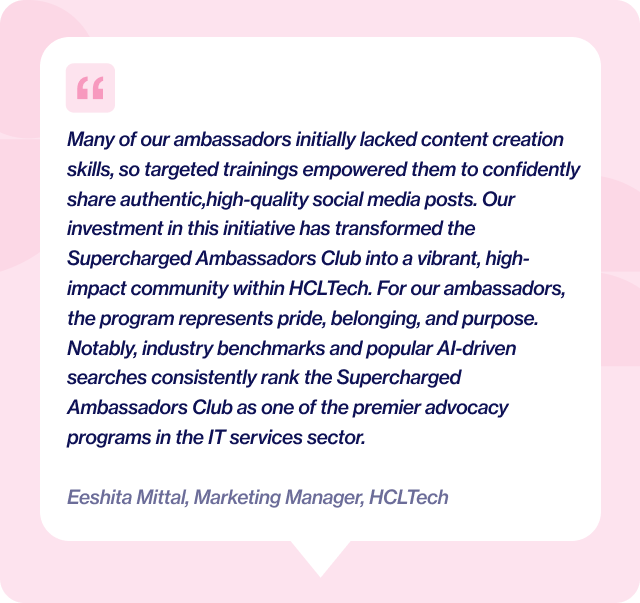
To prevent advocacy from becoming a “one and done” fling (which can happen after an initial enthusiastic launch), focus on building community among your employee advocates. The idea is to create an environment where advocates feel part of something bigger – a movement or club within the company – and can encourage one another.
Consider establishing an Advocacy champions group. This might be an online community (e.g., a Teams/Slack channel or an internal forum) where advocates can share tips, ask questions, or even celebrate personal wins. For example, someone might post, “I wrote my first LinkedIn article today!” and others can like and support them. Marketing/Advocacy leaders can drop updates (“New content added to the platform today – check out the article on AI trends, it’s a hot topic!”) or even share external articles about personal branding to keep inspiration levels high. When advocates interact with each other, it fosters a sense of camaraderie – we’re all in this together.
You can also host periodic events for advocates. Maybe a quarterly “Advocacy Town Hall” webinar where you discuss results, share upcoming plans, and invite a few power-users to share their experiences. Or organize a small reward event – if in-person, a breakfast or coffee meetup for local advocates to network, or if remote, a virtual coffee chat. These gatherings make participants feel valued and help maintain momentum.
Another effective practice is peer challenges – for instance, have each advocate tag another in a post, or pair up people from different departments to collaborate on a piece of content (“Interview each other for a joint blog or LinkedIn Live session”). Such initiatives not only generate fresh content but also weave advocacy into the company’s social fabric.
It’s also important to keep leadership engaged in the community. Perhaps an executive sponsor occasionally drops a message like “Loving the activity I’m seeing here, thanks for representing our company so well!” This reinforces that upper management is watching and appreciating the efforts.
Continuous communication is key. Don’t let the program run on autopilot; keep nudging (without spamming). A weekly or biweekly update (via email or in the community channel) that highlights “Top Content of the Week” or shares a quick tip keeps advocacy on the radar. People are busy, so gentle reminders help. Just vary the format and keep it high-value so it doesn’t become noise.
Lastly, remain receptive to feedback and adapt. Encourage advocates to voice what’s working and what isn’t. Maybe they’ll tell you certain types of content feel too “corporate” or that they want more how-to guides to share. Listen to your audience and adjust your content and approach. When employees see their feedback being acted on, they feel greater ownership of the program, which, in turn, boosts engagement.
By building a community and nurturing it, you turn advocacy from a task into a social experience – one that fulfills basic human desires for connection and belonging. Advocates will not want to let their team down, and they’ll celebrate each other’s successes. This spirit can carry your program through the natural lulls that might occur after launch. (In fact, employee advocacy programs typically go through phases of excitement, dip, and then sustained growth – the “Employee Advocacy Hype Cycle” as one Oktopost blog describes. Focusing on community helps you navigate that dip and come out stronger with a true company-wide movement.)
Measuring employee advocacy success and optimizing over time
Activation is not a one-time project but an ongoing process of measurement and refinement. To ensure long-term success, you need to track progress, show results, and be ready to adapt your strategy. Here’s how to approach this phase:
- Define KPIs and Track Them: From the outset, establish which metrics matter to you and your stakeholders (refer back to personas such as the Marketing Director or Sales Leader). Common employee advocacy KPIs include: number of active advocates (how many employees shared something in a given period), total reach of employee shares, engagement metrics (likes, comments, shares on employee posts), referral traffic to website from employee links, and even conversions or influenced deals (if you can track that far). Also measure qualitative factors such as improvements in employee sentiment or anecdotal sales feedback (“Sales reps say prospects mention our LinkedIn content in calls now”). Use analytics from your advocacy platform and web analytics (UTM tags on links, etc.) to gather hard data.
- Social Selling Index & Individual Growth: If social selling is a goal, monitor team SSI scores over time. Are they improving after training and regular posting? Highlight individual improvements (“Our Sales team’s average SSI went from 55 to 70 in six months, indicating much stronger LinkedIn engagement”). Similarly, track growth in employees’ network sizes or follower counts – these are proxies for personal brand growth. It can be motivating for individuals to see “I gained 100 new connections since I started posting regularly.”
- Report and share results: Regularly report on these metrics to both leadership and advocates. For leadership, tie advocacy metrics to business outcomes, such as brand impressions, engagement rate lift, web traffic, lead generation, or hiring referrals. If you can show a chart of rising engagement correlated with the program launch, that’s powerful. For employees, share collective achievements: “Together, you all drove 50,000 impressions this quarter – that’s 3x our company page reach!” Also, share any standout posts (maybe one employee’s article went viral – celebrate that). This reporting not only justifies the program but also maintains enthusiasm by showing it’s working. According to LinkedIn’s own study, content gets 2x higher engagement when shared by employees, so over time you should clearly see an uptick in overall engagement – make sure everyone knows their effort contributed to that success.
- Adjust strategy based on data: Use the insights to refine content and tactics. For example, if you notice that employees rarely share video content but simple text posts are, perhaps your workforce or their networks prefer a certain format – adjust your content mix accordingly. Or if one department has low participation than others, maybe meet with them to understand the barrier (it could be that their manager isn’t encouraging it, or they don’t find the content relevant – issues you can address). Keep an eye on who drops off after the initial participation; it might signal a need for a new spark (such as another training refresher or a new incentive). Essentially, adopt a continuous improvement mindset: plan, execute, measure, learn, adjust, then repeat.
- Brace for the “Hype Cycle” and persist: As mentioned, advocacy programs often start with a burst of excitement (everyone’s gung-ho in the first month), followed by a potential dip in activity as novelty wears off or other work takes precedence. This is normal. The Employee Advocacy Hype Cycle outlines these stages: launch enthusiasm, a dip when engagement may lull, and steady growth as the program matures and becomes ingrained. Don’t declare failure at the first dip. Anticipate it and have plans to reignite interest (new campaigns, a mid-year contest, fresh leadership comms). Patience and consistency separate programs that fizzle from those that flourish long-term. Communicate this reality to stakeholders: long-term success is the goal, and it requires nurturing.
- Scale what works: As the program gains traction, look for opportunities to scale up. If you started with a pilot group or one region, consider expanding to more users or other regions. Even extend beyond LinkedIn to other platforms if relevant (though LinkedIn will likely remain primary for B2B). Use your advocacy stars as internal evangelists to recruit new participants. Also, update the training content as needed (maybe add an advanced session for veteran advocates who are now looking to do more, such as creating their own original content).
By diligently monitoring and iterating, you ensure that your employee advocacy program doesn’t stagnate. Instead, it evolves and improves over time – delivering increasing value to the business and participants. The data-driven approach will also help you maintain executive support (they love numbers). And for employees, seeing progress (both personal and company-wide) keeps them engaged in the mission.
In summary, activating disengaged employees as brand advocates is a journey. We started by understanding the problem and have now outlined a comprehensive solution: from getting leadership on board and training employees, to providing technology and content, to incentivizing employees and cultivating a community, all anchored in continuous improvement. Now, let’s look at a real-world example of how these tactics come together to drive success.
Employee advocacy case study: Turning disengagement into revenue
To ground these concepts, let’s examine a real B2B company that successfully activated its employees and the results they achieved. CBIZ, a leading professional services firm, faced the common challenge of limited social engagement. They decided to implement a structured employee advocacy and social selling program using Oktopost. Here’s a snapshot of their journey and outcomes:
Background: CBIZ had a broad team, including many consultants and sales professionals who were not very active on LinkedIn. The marketing team wanted to amplify content reach and also help the revenue team leverage social networks for selling. They rolled out Oktopost’s Employee Advocacy platform. They paired it with ongoing training for their staff – echoing many strategies we discussed: scheduling content for consistency, training employees on social media best practices, and providing a mix of content to share.
Strategy:
Scheduled Posting & Consistency: CBIZ maintained a varied, consistent posting schedule through Oktopost, ensuring that both corporate and employee posts went out regularly across service lines. This kept their social presence active at all times.
Employee Advocacy Enablement: They empowered their revenue team with tools and training, making it easy for consultants and sellers to share content. Continuing education was provided, likely building employees’ confidence and personal branding skills (addressing root causes such as confidence and time). Over time, more of their team adopted social selling practices as routine work.
Tailored Content: CBIZ didn’t take a one-size-fits-all approach. They managed diverse content tailored to LinkedIn’s audience and likely relevant to different practice areas, so employees could share content that fit their expertise. This ensured authenticity and relevance in what was shared.
Results: The program delivered impressive results: CBIZ saw a 67% increase in LinkedIn engagement after implementing these initiatives. In other words, posts were getting far more likes, comments, and shares than before – a direct indicator that employee amplification was working. But it didn’t stop at engagement metrics. This surge in activity also translated into tangible business value: roughly $800,000 in revenue was attributable to social media activities during the period measured. That’s a significant ROI, showing that the advocacy and social selling efforts helped bring in new business (or accelerate existing deals). Perhaps a connection made via an employee’s LinkedIn post led to a sales meeting, which became a deal – the kind of win that justifies the entire program.
CBIZ’s CMO, reflecting on the program, highlighted how Oktopost enabled them to strategically curate diverse content and maintain an engaging presence, transforming their social media approach. This underscores the power of having the right platform + strategy. It wasn’t luck – it was the result of deliberate actions: equipping employees, offering varied content, and making advocacy part of their routine.
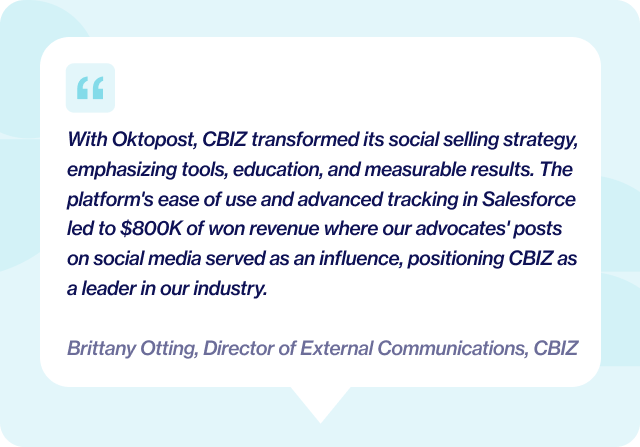
Key Takeaway: The CBIZ case exemplifies the potential “before and after” of employee advocacy. Before: a relatively quiet social footprint, underutilized employee networks. After: a vibrant, engaging multi-voice presence that not only boosts vanity metrics but also drives revenue. The success came from combining technology (Oktopost’s platform) with strategy (education, content planning, and incentives). It’s a validation that when disengaged employees are properly activated as brand advocates, they truly become a force multiplier for marketing and sales outcomes.
For any organization still on the fence, cases like this provide proof that employee advocacy isn’t just hype – it’s a practical driver of business growth when done right. And importantly, note that employees at CBIZ weren’t just posting more – they were doing so strategically (thanks to training) and presumably enjoying recognition for it, which creates sustainability.
(Feel free to explore more success stories on Oktopost’s website – e.g., tech company IFS saw a 394% rise in social engagement in two years by leveraging advocacy, and others like ComplyAdvantage grew their active advocates dramatically – evidence that these principles can work across industries.)
Next steps: How to launch a successful employee advocacy program
Disengaged employees on social media are not a fixed reality – they’re a dormant resource waiting to be energized. By addressing the root causes and implementing a thoughtful advocacy program, you can turn that around and create a robust team of employee brand ambassadors. The benefits are clear: a wider reach on platforms like LinkedIn, greater trust through authentic voices, more engaged audiences, leading to more leads and sales, stronger personal brands for your employees (which boost morale and retention), and a magnetic employer brand that attracts talent. In essence, activating employees as advocates creates a win-win-win: for your company, your employees, and your audience.
Now, the next step is yours. It’s time to put this guide into action within your organization. Start with small steps – maybe rally a pilot group of enthusiastic employees – and build from there. Measure progress, celebrate wins, and continuously refine your approach. Remember, success won’t happen overnight, but with persistence, you’ll see the cultural shift and tangible outcomes we’ve discussed.
Ready to empower your employees and amplify your brand? Oktopost is here to help. As a comprehensive B2B social media management and employee advocacy platform, Oktopost provides the tools and expertise to execute on all the strategies outlined in this guide. From a seamless advocacy board for easy sharing to robust analytics that tie social activity to real ROI, our platform is built to make employee advocacy effortless yet rewarding. Moreover, with resources like the Oktopost Employee Advocacy Academy, you can access expert-led training to ensure your team has the knowledge and confidence to succeed (and even earn a certification to showcase their leadership in this space).
We invite you to take action:
Explore Oktopost’s Employee Advocacy Solution: See how our platform can kickstart your program – with features for content curation, gamification, and integration into your existing social strategy.
Request a Personalized Demo: Sometimes seeing is believing. Book a demo to watch Oktopost in action for your use case – learn how you can centralize content, enable one-click sharing, and track the impact down to leads and revenue. Our team can share success stories and help you build the business case for your leadership.
Leverage the Oktopost Academy: If you’re already an Oktopost customer (or become one), unlock the Academy’s courses on B2B social strategy and employee advocacy. Train your team with the latest best practices and get them certified as B2B Advocacy Leaders – a great way to boost internal credibility and confidence in running the program.
The journey to activate your disengaged employees starts now. Every big success story – like the ones we highlighted – began with the decision to empower their people. Imagine a future where your LinkedIn feed is alive with posts from colleagues, your brand is omnipresent through hundreds of authentic voices, and employees thank you for helping them build their personal brands. That future is within reach.
Activate your advocates, amplify your brand. Don’t let that potential energy go to waste – channel it with the right strategy and tools. We’re here to partner with you in turning your employees into powerful advocates. Let’s transform your social media presence together – one employee post at a time.
p.s.If you found this guide useful and want more insights, or if you’re curious about the Employee Advocacy Hype Cycle and other advanced topics, be sure to check out Oktopost’s blog and resources for further reading. And as always, feel free to reach out to our team – we’re passionate about employee advocacy and ready to help you succeed.
References
- Launch a LinkedIn Employee Advocacy program that works.
- LinkedIn Social Selling Index (SSI) – What Do I Need to Know as an SDR? – Kondo
- Why your employees don’t share content, and how to fix it
- Oktopost Academy Launches B2B Social Media Training
- How Corel Built a Thriving Community with Employee Advocacy
- B2B Social Employee Advocacy Platform – Oktopost
- Employee-posted content has 8x the engagement of branded content. | Adam Rushlow
- Fix inefficient social media engagement for B2B growth
- Social Media Employee Advocacy Tool