


- The execution gap is the distance between having content and having it approved, attributed, and live. Most AI tools stop at drafting and leave the rest manual.
- A real agent does three things: executes inside your systems, reasons across dependent steps, and closes the loop by reading performance data back.
- Before: 30 minutes across five tools per blog post. After: one prompt to Claude, campaign created, three network-adapted posts drafted, advocacy stories built, all routed for approval in under two minutes.
- The Oktopost Claude Plugin is open source under Apache 2.0, a separate layer on top of the Oktopost MCP server's roughly 40 raw API tools.
- Six questions expose whether a vendor sells execution or just faster drafting: can it create a campaign directly, route for approval, write network-adapted copy, reach advocacy boards, read analytics, and where does it stop.
The Oktopost Claude Code Plugin is the first Claude Code skill purpose-built for B2B social media workflows, designed to execute what most AI tools leave unfinished. It connects Claude directly to your campaign management, approval routing, and employee advocacy systems, so a single prompt executes what used to take 30 minutes across five tools. That gap between having content and getting it scheduled, attributed, approved, and live is where B2B social breaks down.
The Oktopost Claude Code Plugin closes it, not by generating more content, but by executing the workflow that turns content into measurable business impact.
Several platforms ship community MCP servers or raw API integrations. None are structured as a Claude skill with B2B workflow awareness, approval routing, and Salesforce attribution built in.
That’s where the execution gap becomes expensive.
You spend 30 minutes every time a blog post goes live. One window for the campaign setup. Another for LinkedIn copy. A third for X. A fourth for your advocacy board. Maybe a fifth for the brief you paste into a writing tool to get the post started. Five tools, one task, half an hour. Multiply that by every asset your team produces, and the problem stops being a productivity issue and becomes a structural constraint.
The reason AI hasn’t fixed this yet isn’t a model problem. It’s an integration problem.
What most “AI marketing agents” actually do
The category label “AI marketing agent” has expanded faster than the underlying capability. Most products that carry it today deliver real value in content generation, but they stop at the point where execution begins. They accept a prompt, return copy, and stop there. The marketer still opens Oktopost, pastes the copy, selects networks, assigns a campaign, routes for approval, and separately sets up the advocacy story. The AI saved a few minutes of drafting. It didn’t save the workflow.
That gap has a name in B2B: the execution gap. It’s the distance between “I have content” and “that content is approved, attributed to pipeline, and live across every channel that drives revenue.”
For enterprise B2B teams, the execution gap is where time disappears. Content strategy, approval cycles, campaign attribution, employee advocacy amplification: none of these live inside a writing tool. They live inside your social management platform. An AI that cannot reach those systems cannot close the gap.
This is distinct from the volume problem that content AI solves reasonably well. Generating a first draft faster is real value. But in B2B, the draft is rarely the bottleneck. In most organisations, those 14 operational steps span multiple systems, teams, and approval layers. That’s where execution breaks, not content creation.
The three things a real AI marketing agent must do
Strip away the category noise and a real AI marketing agent is defined by three capabilities that separate execution from assistance.
It executes inside your systems, not alongside them. Creating a campaign in Oktopost, assigning messages to networks, routing to an approval workflow, and setting up an advocacy board story are not writing tasks. They’re operational tasks. An agent that cannot call those actions is a draft generator. An agent that can call them is an execution layer.
It reasons across steps. A multi-step workflow has dependencies. The advocacy story cannot go out before the campaign exists. The post cannot be scheduled before approval clears. A real agent tracks state across those steps and resolves them in order. It doesn’t produce five outputs and ask you to assemble them.
It closes the analytics loop. Publishing isn’t the end of the workflow. In B2B, social performance data feeds back into decisions about budget, cadence, channel mix, and message framing. An agent that can read performance data and surface insights from it is operating as a marketing intelligence layer, not just a content layer.
Most tools in the market today do none of these three things. A few do one. The category, when measured against real B2B execution requirements, is still largely aspirational.
Why B2B social is the hardest use case
Consumer social is relatively forgiving. A wrong post can be deleted. Attribution is approximate. Approval is usually one person.
B2B social operates under different constraints. Most enterprise teams require multi-step approval before anything publishes. Campaign attribution must be exact: every post needs a campaign association or the click data is orphaned. Employee advocacy is a core distribution channel, not an afterthought, and it requires coordinated content that looks authentic at the individual level while staying on brand at the company level.
These constraints are the default operating conditions for the teams buying social management software, not edge cases.
This is why the execution gap is specifically a B2B problem. Consumer AI tools can afford to generate and stop because publishing is simple. B2B AI tools can’t afford that because publishing is the start of a compliance, attribution, and amplification chain that has real revenue consequences downstream.
A missed attribution link means a deal that closed through social gets credited to direct. An unapproved post in a regulated industry means a compliance incident. An advocacy story that never gets created means 200 sales reps never amplified content that would have reached 40,000 of their connections.
These aren’t abstract risks. They happen when the execution gap isn’t closed.
What the Oktopost Claude Plugin does differently
The Oktopost Claude Plugin is the first Claude Code skill purpose-built for B2B social media workflows.
It closes the execution gap by running inside Oktopost rather than alongside it. Through the Model Context Protocol, Claude has direct access to Oktopost’s campaign management, post scheduling, approval routing, and employee advocacy systems. A single prompt can trigger the full operational chain.
The Oktopost MCP server at mcp.oktopost.com exposes approximately 40 raw API tools for developer use. The Oktopost Claude Plugin is a separate layer on top: a B2B strategist skill that wraps those tools with workflow logic, approval awareness, and Salesforce attribution. The MCP provides access. The plugin applies workflow logic, approval awareness, and execution discipline to turn that access into action.
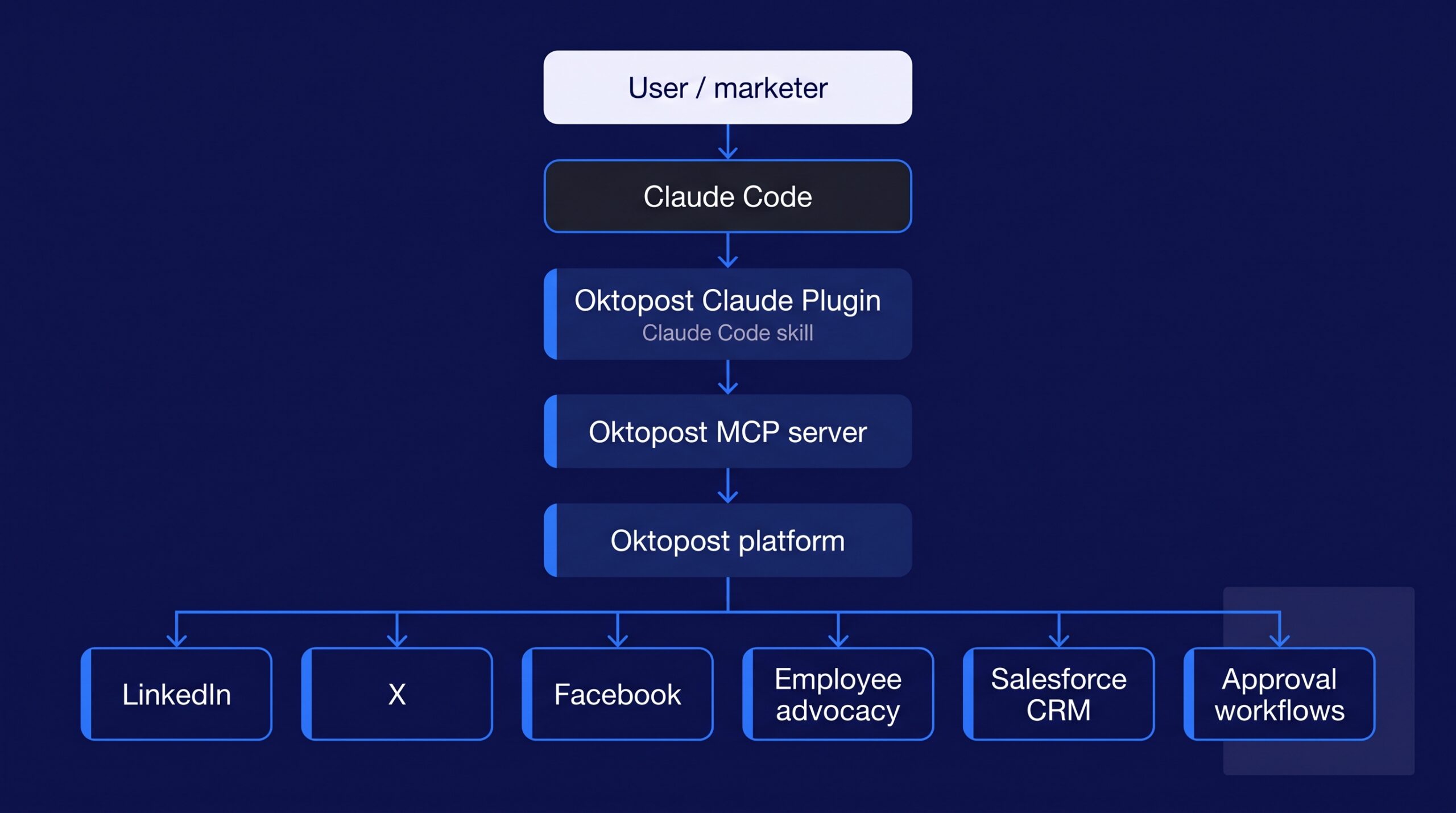
The before and after looks like this:
Before: Blog post goes live. Marketer opens campaign tool, creates campaign. Opens social tool, drafts LinkedIn post. Drafts X post. Drafts Facebook post. Opens advocacy board, writes three story variants employees can share. Checks character limits. Routes each post for approval. Total time: 30 minutes, five tools.
After: One prompt to Claude with the blog title and URL. Claude creates the campaign in Oktopost, drafts three network-adapted posts (LinkedIn, X, Facebook), creates three advocacy board stories with authentic employee-voice variants, validates character limits per network, and routes everything to the approval workflow. Total time: under two minutes, with campaign structure, attribution, and approvals already in place.
More importantly, the output isn’t content to be actioned later, it’s structured work already inside your system of record. It’s live content inside Oktopost, ready for the approver’s queue, not a document to paste from.
That’s what the execution gap looks like when it’s actually closed: not fewer writing steps, but fewer operational steps across the entire chain from content creation to approval to advocacy distribution.
The Oktopost Claude Code Plugin is open source under the Apache 2.0 license. The repo is at github.com/Oktopost/oktopost-claude. No form, no gate.
For setup steps and the full command reference, see the README on GitHub. For the product overview and how teams are using it, see the Oktopost Claude Plugin page.
Six questions to ask any “AI marketing agent” vendor
If you’re evaluating an AI marketing agent, these six questions will tell you very quickly whether you’re buying execution or just faster drafting.
1. Can it create a campaign in my social management platform directly? Not export a brief. Not generate copy. Actually create the campaign record.
2. Can it route content to an approval workflow? If your team requires approval before publishing (most B2B teams do), an agent that bypasses or cannot reach that workflow isn’t production-ready.
3. Does it write network-adapted content or the same copy for every channel? LinkedIn and X require different character counts, tone registers, and hashtag strategies. A tool that writes once and replicates isn’t adapting.
4. Can it set up employee advocacy distribution? If it cannot push content to an advocacy board, it’s not touching 60-80% of your total social reach.
5. Can it read your analytics and inform the next action? A closed loop requires input from both ends. Can the agent tell you which message variant is outperforming and why?
6. Where does it stop? Every vendor will describe what the tool does. Ask them explicitly where the human has to take over. The answer maps the execution gap precisely.
The category will catch up. The question is when.
The “AI marketing agent” label will normalize over the next 12-18 months. The tools that carry it today will either close the execution gap or be replaced by tools that do. The market is moving from AI-assisted drafting toward AI-executed workflows, and B2B social is one of the clearest test cases because the workflow complexity is high, the attribution stakes are real, and the tool fragmentation is already well documented.
If you manage B2B social today, the practical question isn’t whether to adopt an AI marketing agent. It’s whether the tool you’re evaluating actually executes or whether it generates and stops.
In B2B, that distinction isn’t nuance. It’s the difference between activity and revenue.
If you want to see what execution actually looks like, start with the open source Oktopost Claude Plugin on GitHub. github.com/Oktopost/oktopost-claude, or read the full glossary definition of AI marketing agent.
Because this category won’t be defined by who generates the most content.
It will be defined by who gets that content live, attributed, and driving pipeline.