



Key Takeaways:
- A structured, seven-step framework is essential for launching and scaling employee advocacy programs with governance, compliance, and measurable business impact.
- Segmenting content and permissions by role and region, combined with AI-powered compliance checks, ensures global governance and empowers employees to participate confidently.
- Measuring advocacy success requires connecting employee activity to sales pipeline and revenue, using analytics and CRM integration to prove ROI and drive sustained engagement.
Your employees already have the credibility, expertise, and professional networks that influence buying decisions on LinkedIn every day. A well-structured employee advocacy program turns that existing influence into a scalable driver of brand visibility, trust, and pipeline growth. The challenge is scaling advocacy in a way that empowers employees while maintaining governance, compliance, and brand consistency across teams and regions. That’s where the right framework, and the right platform, becomes critical.
Follow a 7-step framework to scale employee advocacy across teams and regions
Building an employee advocacy program that works across teams and regions requires a structured approach that balances employee empowerment with brand control. These employee advocacy program steps create the foundation for sustainable growth and measurable business impact.
- Step 1: Define clear business outcomes and KPIs that align marketing, sales, and compliance teams around shared goals like pipeline influence, account engagement, and brand reach. Focus on business metrics that connect employee advocacy to engagement from target accounts, pipeline influence, and revenue outcomes.
- Step 2: Secure executive sponsorship by demonstrating how employee advocacy expands trusted reach, strengthens brand credibility, and increases visibility with target accounts. When employees feel connected to their company’s values and purpose, their willingness to advocate for their employer increases, research from Harvard Business Review shows employees are more likely to advocate when they feel connected to company purpose and values.
- Step 3: Segment your audience by mapping teams, regions, and roles to ensure content relevance and appropriate permissions. Different departments need different messaging, and regional teams require localized compliance guidelines.
- Step 4: Centralize approved content in a governed advocacy platform where AI-assisted personalization helps employees tailor posts in their own voice while staying aligned with approved messaging and brand guidelines. This approach reduces the fear of saying the wrong thing while scaling participation.
- Step 5: Launch with a pilot group of engaged employees who can provide feedback and become program champions. Use their insights to refine workflows before expanding company-wide.
- Step 6: Enable ongoing training and recognition through role-specific training scenarios, regular content refreshes, and gamification elements like leaderboards. Long-term participation depends on ongoing enablement, fresh content, and employee recognition.
- Step 7: Measure advocacy performance using analytics tied to pipeline influence, engagement quality, and revenue attribution. Track activation rates, content reach, engagement from target accounts, and influenced opportunities. Connect social activity directly to your CRM and marketing automation platform to prove advocacy’s impact on pipeline and revenue generation.
Ensure global governance, compliance, and enablement across regions
Scaling advocacy globally requires governance frameworks that support employees while ensuring regional compliance and brand consistency. Effective employee advocacy governance and compliance frameworks prevent these scenarios by building structured controls that balance empowerment with risk management across teams and regions.
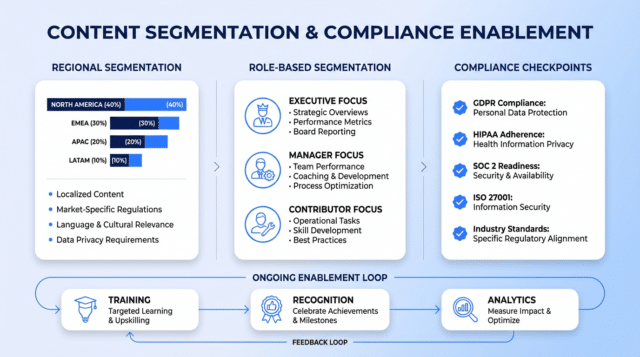
Segment content and permissions by role and region
Build content libraries tailored to specific departments, regions, and roles. Sales teams need different messaging than HR, and European teams require different compliance language than teams in North America. Role-based permissions ensure employees access only content relevant to their function and geography, reducing confusion while maintaining brand consistency.
Implement compliance guardrails with AI-powered review
Deploy automated compliance checks that flag potential issues before content goes live. For financial services firms, this includes recordkeeping requirements and principal approval workflows. Automated review workflows help teams identify compliance risks before content is published, helping employees participate confidently while maintaining governance standards.
Establish ongoing enablement and recognition systems
Provide scenario-based training that addresses real-world situations employees face when sharing content. Regular content refreshes keep messaging current and relevant. Encourage participation through leaderboards, recognition programs, and employee spotlights that reinforce positive engagement. Track data protection compliance when measuring employee participation across regions. Monitor governance effectiveness through participation rates, compliance scores, and content performance to prove program value.
Put the system in motion: Govern, scale, and prove impact
Employee advocacy delivers the greatest impact when it becomes part of a broader company-wide social strategy, not just a content-sharing initiative. The most successful programs combine orchestrated execution with governed participation and decision-grade metrics that connect directly to pipeline and revenue.
When you build and scale your employee advocacy program with the right governance and measurement framework, your advocates become confident participants who drive real business results, from stronger brand credibility to measurable pipeline influence.
The right platform makes this transformation possible. helps enterprise B2B organizations scale employee advocacy with LinkedIn-first workflows, customizable governance controls, AI-assisted personalization, and deep CRM and marketing automation integrations. Teams can track advocacy performance across engagement, pipeline influence, and revenue attribution while giving employees an easy way to share trusted, relevant content at scale. Ready to launch an employee advocacy program that scales across teams, regions, and business units? Talk to the Oktopost team to see how B2B organizations use advocacy, governance, and attribution to turn employee engagement into measurable business growth.