



- Separate organic and paid social spend when calculating ROI, since they answer different budget questions.
- Define goals first (conversions, sentiment, retention), since the right metric depends on the goal.
- The ROI formula is straightforward once goals are set: (return minus investment) divided by investment.
- Real customer results back the case: one company's webinar registrations from organic ran 5x higher than paid.
B2B Growth Marketing, Demand Generation, Field Marketing—however you badge it, it’s a numbers game. We are here to drive revenue. We are judged by results and the decisions we make about where to invest to get the highest return.
The last few years have been tougher than ever. Traditional channels that used to be our ‘bankers’ disappeared overnight. Budgets and teams have been squeezed, but the targets keep growing.
As someone specialized in Demand Gen, I have to ask myself hard questions. Every day, we ask ourselves the same questions—What’s working? Where can I get more quality opportunities for the sales team today?
Yet, organic social media is one channel that still delivers consistent results.
I don’t know about you, but I hate spending other people’s money, especially when I am not sure what I am going to get for it. Many marketers shy away from social media because they don’t understand how to measure social media return on investment (ROI).
Measuring the ROI on social media is easy once you know what you’re looking for.
Quick jump to section
Why measure social ROI
I believe in the power of brand, I know that familiarity and consistency breeds trust, and I don’t buy into the notion of awareness being of lower strategic importance than demand as an objective. But I also know that every dollar, every minute of effort a marketing team invests, needs to have an expected, measurable outcome attached.
And when you have to prove the return on investment of each and every red cent, it can be difficult to justify increasing spend on organic social over Facebook ads.
And that is why until recently, outside paid advertising, I didn’t think of social as a demand generation tool because I didn’t know that you could really measure it.
I don’t mean how many clicks and likes and shares did whichever post get. I mean, who is clicking on the links to my content, who is engaging with what we are talking about—and what step do they take next?
A social media manager is often confronted with the problem of “how do we know we’re reaching the right people?” and “how can we prove that these posts are making an impact?”
This is where social media ROI metrics come into play.
How to measure ROI in social media marketing
If you’re using a great social media management platform to help calculate your social ROI, then this becomes a lot easier.
Otherwise, it’s time to whip out your calculator and perform a social media audit.
Determine your total social media spend
I find that it helps to separate spend between organic and paid social media. You can still calculate the combined total spend vs social impact later, but I think it’s interesting to see how your organic social is performing against your social ads.
For organic social media, it might be:
- Costs of your social media management platform/tools
- Any content creation or design costs (whether in-house or outsourced)
- Your social media team salaries
For paid social, you might also include the amount of your ad spend to the above costs, as well as anything else you’re paying for (ad visuals, ad copy, etc.).
From there, it’s time to determine your goals.
Define clear goals to measure against your social networks
What do you want your social media campaigns to achieve? Are you aiming, like me, to generate leads and opportunities for your sales team? Or are you more focused on using social media for brand awareness?
You might measure any number of things to define clear social goals:
- Conversions, leads, and opportunities
- Brand awareness/brand sentiment
- Customer or employee retention
You should then think about which social metrics correspond to your chosen goals.
Using social media analytics, you can measure:
- Conversion from social media: Sometimes your social media management platform will help you track these. Otherwise, you’ll need to track them through Google Analytics or your CRM software through tracking links.
- Lead generation: Whether you’re pulling organic leads in through lead generation content, webinars, or other gated assets, you’ll need to track them in GA if you don’t have tracking integration in your social management platform.
- Social listening to measure brand sentiment and share of voice: A great social listening tool can help you measure share of voice. With some, you can even perform a sentiment analysis.
- Customer and employee advocacy: Measuring employee advocacy against churn can help you understand the impact your social efforts have on keeping your employees happy. To measure customer advocacy, social listening is the best kind of tool for the job.
Panaya tracks a 23% conversion rate on social this exact way.
How to calculate social media ROI (Formula)
While there are many ways to measure social return on investment, it might be tricky to chalk a dollar amount up to measuring brand awareness. For the other goals that can be measured with a dollar amount, the formula is pretty straightforward. Conversion is easy enough.
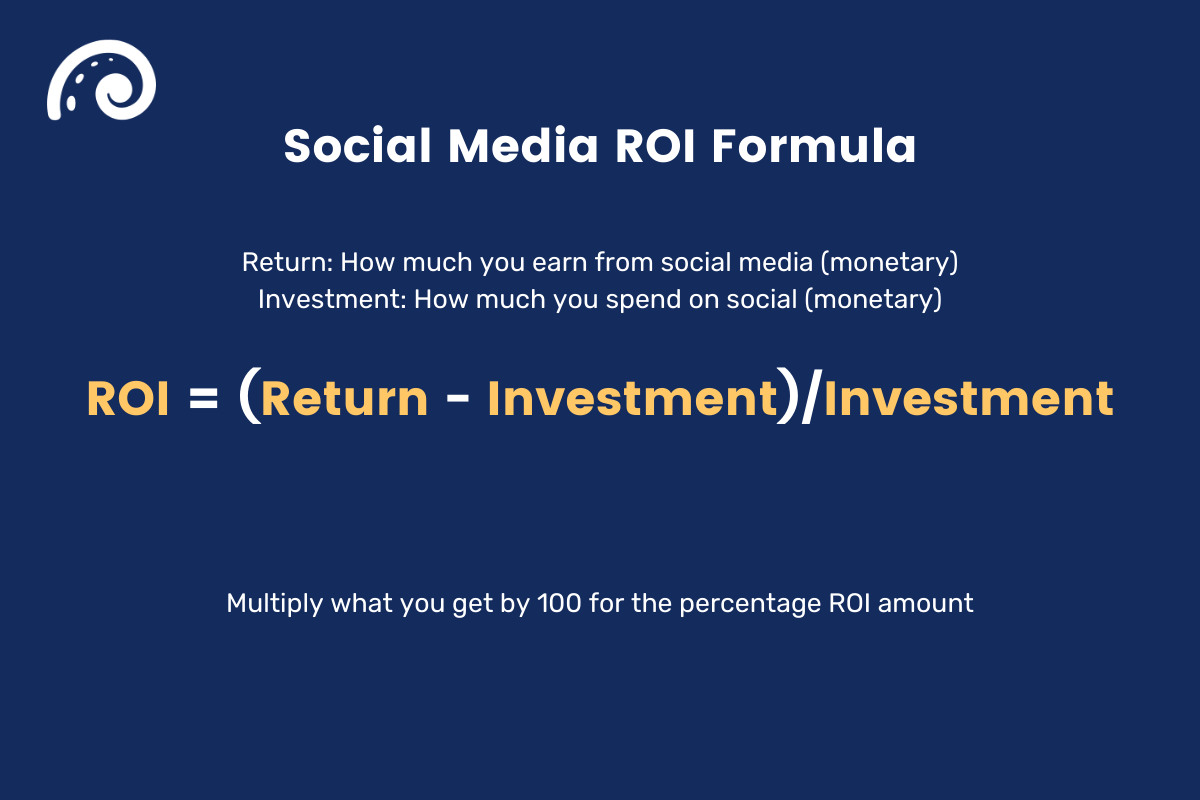
ROI = (Return – Investment)/Investment
So for example, if your quarterly spend for social amounted to $20,000, and your leads from social converted, paying you $45,000, your formula would look like this:
ROI=(45,000 – 20,000)/20,000
ROI=1.25, or 125%
This is a great way to incorporate your social return into your overall marketing ROI calculations.
Final thoughts
In my second week at Oktopost, we ran a customer roundtable. One of our clients stood up and shared that, for a recent webinar they ran as part of a demand generation campaign, registrations from organic social were 5 times higher than from paid advertising.
If you’re building out your B2B growth strategy and are not sure what you can expect to get from social media – check out these stories from Oktopost customers:
As a B2B company, if you’re not doing things on social media, you’re missing out. That’s where everybody is right now: from your top of the funnel engagements to prospects further down in the sales process. If you have a solid social strategy, you don’t really need to spend a lot of money on other channels that everybody used to heavily invest in before,” Patrick Flanigan, SVP of Strategic Marketing at OSG.
Our website traffic from social media has increased by 60% compared to the same period last year. We’re able to make such a concentrated effort to promote our thought leadership content thanks to Oktopost, which allows us to measure, prove, and grow the impact of social media as part of our global marketing strategy. ” DKSH
Certiport saw a 386% increase in conversions after moving to a lead-attribution-first approach to social ROI, a clear sign these metrics translate into real pipeline when you track them consistently.
So if you think social media is not for Demand Gen, look again.
The key to improving social media ROI is making social media measurable. Once you achieve that, social ROI will no longer be a mystery for you.