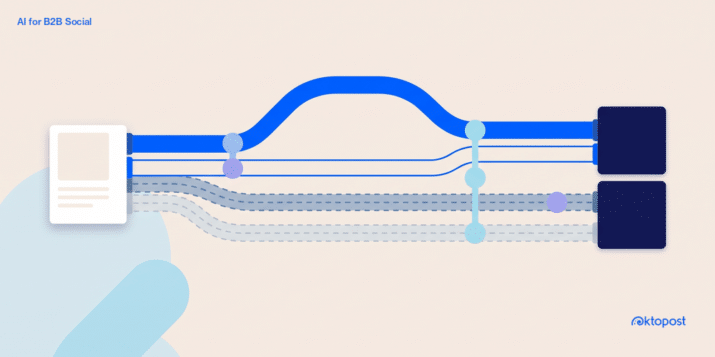



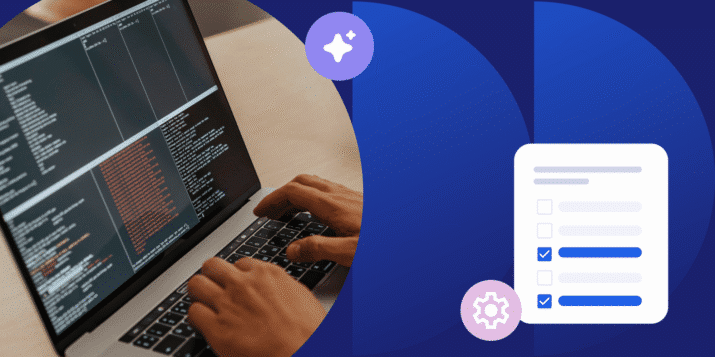
- A scheduling tool executes a task. An AI agent builder coordinates the system: deciding what runs, when, and what happens next.
- Agents can monitor performance data, route approvals by risk level, tag accounts in the CRM, and trigger Marketo or Salesforce actions, all without a person starting each one.
- McKinsey found 88% of organizations now use AI in at least one business function, but there's a real gap between AI that drafts and AI that runs the workflow.
- Oktopost's Agent Builder runs on top of the CRM integrations, advocacy engine, and approval infrastructure a B2B social program already has, not a generic automation layer.
Your B2B social team has tools. It still can’t scale.
Most B2B marketing teams running social media today are not short on software. They have a scheduling tool, a content calendar, an approval process over Slack, a reporting spreadsheet, and a CRM that technically connects to all of it. What they do not have is a way to make those systems work together without a person manually bridging every gap. That coordination problem is exactly what AI agent builder tools for B2B social teams are built to solve.
A social media manager spends hours each week not on strategy or content quality, but on coordination: routing approvals, reformatting posts for different channels, pulling performance data into reports, and chasing employees to share content. This work is time-consuming.
This is the problem that AI agent builders are designed to solve. Not by replacing your team, but by eliminating the manual overhead that keeps your team from doing the work that actually matters.
B2B social has outgrown manual execution and AI agent builder tools are catching up
The volume and complexity of B2B social media has changed substantially in the past five years. What used to be a single LinkedIn feed managed by one person now spans multiple channels, multiple content formats, dozens of employee advocates, and a pipeline attribution requirement that connects social activity to closed revenue.
At the same time, AI adoption across marketing teams is accelerating. According to McKinsey’s 2025 State of AI report, marketing and sales have consistently been the functions where organizations most often report AI use, with 88% of respondents saying their organizations now use AI in at least one business function. But there is a significant difference between AI that helps you write a post faster and AI that runs the workflow around that post end to end.
The first kind of AI is useful. The second kind is transformative. And understanding the difference is the reason more VP Marketing teams are paying close attention to this new platform category.
What an AI agent builder for B2B social teams actually is
An AI agent builder lets you design and deploy autonomous AI agents, software processes that can perceive context, make decisions, and take actions across multiple systems without requiring a human to approve each step.
That definition matters because it is fundamentally different from what most marketing teams think of when they hear “AI.” A writing assistant generates content when you ask it to. An AI agent watches for a trigger, evaluates conditions, routes to the right action, and executes, all without a prompt from you.
Agents built on these platforms can:
- Monitor performance data and surface anomalies in real time
- Route content through approval workflows based on content type, risk level, or region
- Tag accounts in your CRM based on social engagement signals
- Trigger downstream actions in Marketo or Salesforce when a prospect interacts with a post
- Distribute content to employee advocacy boards based on audience segment or topic tags
None of that requires a human to initiate it. The agent observes, decides, and acts. That is the core distinction that makes this category different from every other marketing automation tool you have used. If you want to see the mechanics of that first build, this walkthrough on building your first AI agent without engineering support covers the setup step by step.
Execution vs. orchestration: the distinction that changes everything
To understand why AI agent builders matter specifically for B2B social teams, you need to separate two concepts that often get conflated: execution and orchestration.
Execution is doing the task. Scheduling a post, writing a caption, resizing an image, sending a notification. Most AI marketing tools today are execution tools. They make individual tasks faster. They do not change how your workflow operates.
Orchestration is coordinating the system. Deciding which task runs, when it runs, what triggers it, what happens next, and how it connects to the actions happening in other systems at the same time. Orchestration is what turns a collection of tools into a program that runs without constant human intervention.
A scheduling tool executes. An AI agent builder orchestrates.
The shift from execution tools to orchestration platforms is not a minor software upgrade. It is a category change. Teams that operated around tools now operate through systems. The human role moves from doing the work to designing the workflow and reviewing the output. That is where the real productivity gain lives, and it is why this category is getting serious attention from B2B marketing leaders who have already bought every execution tool on the market.
This shift also connects directly to what marketing workflow automation is evolving into: not just automating individual steps, but building intelligent processes that respond to data and act without manual triggers at every junction.
What AI agent builder orchestration looks like for B2B social teams
Approval workflows that route themselves
Instead of a social media manager manually sending posts to the right reviewer and following up over Slack, an orchestrated workflow evaluates the content type, applies the correct compliance path, sends it to the right approver, and escalates automatically if approval is not received within a defined window. The manager sets the rules once. The agent runs it every time.
Employee advocacy that activates without reminders
Most employee advocacy programs fail not because employees do not want to participate, but because the coordination is manual. Current employee advocacy data backs this up: authentic, low-friction participation is what drives results. An orchestrated advocacy workflow assigns content to employee boards based on role, seniority, or topic affinity, sends the notification through the right channel at the optimal send time, and tracks participation without any manual input from the social team.
Performance data that triggers action
When a LinkedIn post significantly outperforms benchmarks, an orchestrated workflow surfaces the signal, identifies the content attributes driving performance, and routes that data back into the content planning queue. The insight becomes a workflow input, not just a dashboard metric someone reads and forgets.
CRM connections that close the attribution loop
When a target account engages with your social content, an orchestrated workflow can tag that activity in Salesforce, alert the account owner, and trigger a follow-up sequence in Marketo, all without anyone switching between tabs.
How Oktopost’s AI agent builder makes this real for B2B social teams
The Oktopost Agent Builder is built specifically for the workflow challenges B2B social media teams face. Not generic marketing automation. Not a no-code tool that requires an engineer to maintain. A purpose-built layer designed around the actual programs social teams run: multi-channel publishing, employee advocacy, compliance review, and pipeline attribution.
Oktopost Agent Builder connects across your existing stack. An agent can watch LinkedIn performance data, route high-performing content to employee advocacy boards, tag account activity in Salesforce, and trigger Marketo sequences, all inside the same platform where your social program already runs.
This matters because orchestration only works when it has access to the right data. Most AI agent builder tools are general-purpose. Oktopost Agent Builder is built on a platform that already has the CRM integrations, the advocacy engine, the approval infrastructure, and the LinkedIn attribution. The agents run on top of a system that already knows what a B2B social program looks like.
The teams that move first have the advantage
B2B buyers research extensively before they talk to sales. They read content, follow company pages, engage with thought leadership, and check employee networks for social proof. Gartner finds that 65% of CMOs expect AI to dramatically change their role within two years, and the teams already using agentic tools to capture buyer signals are building an early structural advantage. Every interaction point is a signal. The teams that capture those signals, route them to the right place, and act on them faster than competitors have a structural advantage that compounds over time.
That advantage does not come from posting more content. It comes from building a program that responds to data at every step, without requiring a human to manage each response. That is what orchestration makes possible, and it is what AI agent builder tools are built to deliver. Before you scale one past a pilot, though, it’s worth asking how much decision-making you actually want to hand off.
Every social platform helps you post. Oktopost helps you act.