



- Likes and shares show whether people scrolled past. They don't show whether anyone on the buying committee noticed. Track account-relevant reach, saves, and click-throughs instead.
- Attribution only works with the infrastructure in place first: consistent UTM parameters, CRM integration, and standardized campaign naming.
- The real story is sourced vs. influenced pipeline. Influenced pipeline is usually 3x to 5x larger than sourced pipeline, and most teams only report the smaller number.
- Employee advocacy content typically outperforms brand-page posts. LinkedIn data shows employee shares get 2x higher click-through rates.
Most B2B buyers research vendors on LinkedIn before they ever speak to a sales rep. That means your LinkedIn presence is shaping purchase decisions in conversations you’re not part of. Marketing teams know LinkedIn matters. Fewer have LinkedIn metrics for B2B marketing that can actually show whether their activity contributed to a closed deal. That’s true everywhere your buyers are, which raises its own questions around scaling your social strategy globally.
The right answer lies in funnel-focused measurement that connects account-relevant reach, quality engagement signals, and conversion outcomes directly to pipeline. That’s a different reporting model from what most teams are running today.
Key takeaways:
- Likes and shares tell you whether people scrolled past your content. They don’t tell you whether anyone on a buying committee noticed it. Focus instead on account-relevant reach, saves, click-throughs, and engagement from the job titles that actually sign contracts.
- Attribution only works if the infrastructure is in place first. Consistent UTM parameters, CRM integration, and standardized campaign naming are what separate teams that can prove LinkedIn ROI from teams that guess at it.
- The distinction between sourced and influenced pipeline is where LinkedIn’s real story lives. Sourced pipeline is rare. Influenced pipeline, captured through proper funnel tracking, is usually far larger than social teams realize.
Key LinkedIn metrics for B2B marketing: reach, engagement, and conversion
LinkedIn metrics for B2B marketing ROI fall into three categories, each mapping to a different stage of your sales funnel. None of them are likes.
Account-relevant reach
Raw impression counts are close to useless for B2B. What matters is whether your content reached the right people: the VP of IT at a 500-person healthcare company, the CFO who sits on the buying committee, the procurement lead evaluating three vendors.
LinkedIn’s measurement tools offer demographic breakdowns showing impressions by job title, seniority, and company size. Use them. A post that reached 10,000 people but only 3% matched your ICP is a worse outcome than a post that reached 2,000 where 40% did. Track follower growth within target segments, content visibility to priority accounts, and employee advocacy reach separately from brand page reach. Advocacy content routinely reaches audiences your company page can’t access, because it travels through personal networks where your ICP already has trust.
Quality engagement signals
Not all engagement signals carry the same weight. A like takes two seconds. A save means someone thought the content was worth returning to. A comment from a Director of Demand Generation at a target account means someone on a buying committee engaged directly with your thinking.
The signals worth tracking closely are saves, click-through rates to your content, profile visits from target account employees, and meaningful comments from buying committee members. These are intent signals, not vanity metrics. A Social Media Manager at a 600-person SaaS company might set up a saved search in their CRM to flag every time an open opportunity contact engages with a LinkedIn post. That’s the kind of signal that tells sales when to follow up.
Employee advocacy content typically generates stronger engagement than brand page publishing because buyers extend more trust to people than to corporate accounts. According to LinkedIn’s own data, content shared by employees sees 2x higher click-through rates than company page posts. That makes your employee program a reach and engagement multiplier, not just a coverage play.
Conversion and pipeline contribution
This is where LinkedIn activity connects to numbers leadership actually cares about: UTM-tracked clicks to your website, attributed leads from social campaigns, form completions, and pipeline that can be tied back to a social touch. LinkedIn lead generation forms can make demand capture more efficient, but the real reporting value comes from tracking how those leads progress through your sales process using funnel-focused analytics.
Sourced vs. influenced: reporting LinkedIn metrics for B2B marketing correctly
Most social media teams underreport their pipeline contribution because they’re only measuring sourced pipeline, meaning deals where LinkedIn was the first touch. That’s a high bar. In B2B, first-touch attribution from organic social is relatively rare because buyers rarely land on a LinkedIn post and immediately fill out a demo request form.
Influenced pipeline is a different story. This captures every deal where a social touch occurred anywhere along the buyer journey, even if it wasn’t the first touchpoint. A prospect who follows your company page, reads three of your posts over six weeks, attends a webinar you promoted through advocacy, and then books a demo through a paid campaign has social influence all through it. If your reporting only captures the last paid-ad click, you’re attributing the outcome to the wrong channel.
Teams that track both sourced and influenced pipeline consistently find that influenced pipeline from LinkedIn is 3x to 5x larger than sourced pipeline. Reporting only one of them means you’re making a weaker case for social investment than the data actually supports.
From metrics to revenue: connecting social engagement to your go-to-market system
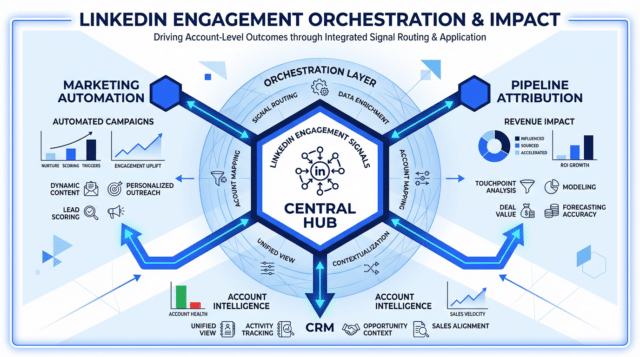
LinkedIn metrics for B2B marketing become useful when they connect directly to your sales pipeline and CRM. Building that visibility requires the right instrumentation, account-based tracking, and a way to compare performance across paid, organic, and advocacy at scale.
Instrumentation: capture every signal
Your LinkedIn content needs consistent UTM parameters, audience-specific landing pages, and automation to pass engagement data into your CRM. LinkedIn’s Revenue Attribution Report connects directly to Salesforce, HubSpot, and Dynamics 365, which gives you a starting point. But UTM coverage alone isn’t enough. You need CRM integration and campaign governance working together to produce accurate attribution reporting, because without standardized naming conventions and automated UTM generation, manual errors accumulate fast and corrupt your data over time.
Think of it as building campaigns designed to track results from click to close. Every asset, every post, every advocacy share should carry campaign tags that let your CRM answer one question: did this social touch contribute to a closed deal?
ABM alignment: track account-level impact
Account-based marketing (ABM) treats specific target companies as individual markets rather than segments in a broad audience. On LinkedIn, that means tracking engagement lift across priority accounts, interactions from buying committee members at those accounts, and content engagement across active opportunities.
The practical application: track which LinkedIn posts drive profile visits from target account employees, saves from decision makers at open opportunities, and comments from buying groups. A post that generates five comments from employees at three different target accounts is more valuable than one with 200 generic likes, even if the latter looks better in a standard performance report. This account-level view shows how social accelerates existing opportunities rather than just generating new leads.
Scaling what works: comparing paid, organic, and advocacy
Once you have the tracking infrastructure in place, the next step is using it to make better decisions about where to put resources. Compare paid and organic performance across equivalent time windows. Measure employee advocacy impact separately, since advocacy reach is structurally different from brand page reach and should be evaluated on its own contribution to pipeline. Look at engagement trends by content format and posting time to find what your specific audience responds to, not what generic best-practice guides recommend.
Social analytics help teams identify which content formats and which employee advocates drive the highest pipeline contribution. That’s the operational intelligence that lets you prove social’s business impact and put more budget behind what’s working, while maintaining the governance and compliance standards enterprise teams require.
Turn LinkedIn engagement into decision-grade B2B marketing metrics
The teams that report social’s pipeline contribution with confidence aren’t doing anything exotic. They’ve put the tracking infrastructure in place, they distinguish sourced from influenced pipeline, and they report account-level engagement to sales alongside aggregate numbers. That shift from counting likes to counting buying committee touches at named accounts is what makes the difference between a social report that gets filed and one that changes a budget conversation.
Oktopost’s social analytics platform helps teams track sourced versus influenced pipeline and measure governed advocacy impact across your entire social program. Talk to one of our experts to align your LinkedIn strategy with measurable business outcomes.