




Key takeaways:
• Move beyond vanity metrics like likes and shares: focus on account-relevant reach, quality engagement, and conversion outcomes that connect LinkedIn activity directly to pipeline and revenue.
• Implement robust tracking and attribution infrastructure, including UTM parameters, CRM integration, and standardized campaign naming, to accurately measure both sourced and influenced pipeline from LinkedIn.
• Use funnel-focused analytics and governed employee advocacy to scale impact, optimize strategies, and confidently report social’s business value to leadership.
LinkedIn has become one of the most important channels in the B2B buyer journey, influencing how buying committees research vendors, evaluate expertise, and engage with thought leadership long before speaking with sales. . The next step is measuring that impact in a way leadership can act on. So, what metrics matter most for LinkedIn in B2B marketing? The answer lies in funnel-focused measurement that connects account-relevant reach, quality engagement, and conversion outcomes directly to revenue. Oktopost, the B2B Social company, helps teams replace guesswork with revenue-focused analytics designed for measurable business outcomes.
The LinkedIn metrics that actually indicate business impact: reach, quality engagement, and conversion
The LinkedIn metrics for B2B marketing ROI go far beyond vanity metrics. While likes and shares might feel good, they don’t tell you if your content is reaching decision-makers or driving pipeline. The metrics that actually matter fall into three categories that map directly to your sales funnel.
• Account-relevant reach: Monitor impressions among your ideal customer profile roles, follower growth within target segments, and content visibility to priority accounts. LinkedIn’s measurement tools now offer demographic breakdowns that show whether your content reaches the right job titles and company sizes. Include employee advocacy reach, engagement from target accounts, and visibility among key buying committee roles within priority accounts.
• Quality engagement signals: Analyze saves (which indicate content worth revisiting), meaningful comments from buying committee members, click-through rates to your content, and profile visits as intent indicators. These signals help identify active interest from potential buyers rather than passive engagement.
Employee advocacy content often generates stronger engagement and credibility than brand-only publishing because buyers trust people more than corporate messaging.
• Conversion and pipeline assist: Assess UTM-tracked clicks to your website, attributed leads from social campaigns, form completions, and most importantly, reporting that distinguishes between sourced and influenced pipeline. Sourced means social was the first touch; influenced means social assisted along the buyer journey. LinkedIn lead generation forms can support efficient demand capture, but the real value comes from tracking how those leads progress through your sales process using funnel-focused analytics.
From metrics to revenue: connecting social engagement to your B2B go-to-market system
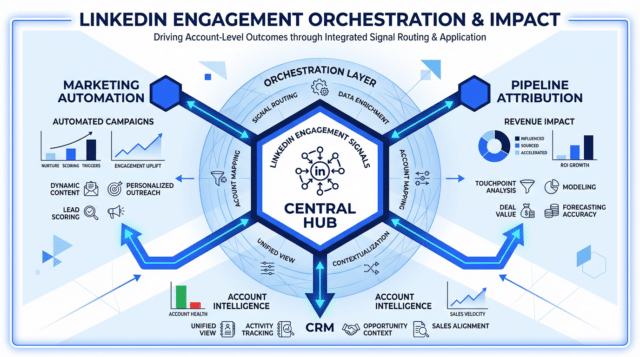
LinkedIn metrics become powerful when they connect directly to your sales pipeline and revenue outcomes. How LinkedIn analytics drive measurable pipeline and revenue for B2B organizations depends on building the right infrastructure to capture, track, and attribute social engagement throughout your CRM and revenue operations infrastructure. Building this visibility requires the right attribution and reporting infrastructure.
Instrumentation: capture every signal
Your LinkedIn content needs consistent UTM parameters, audience-specific landing pages, and automation to pass engagement data into your CRM. LinkedIn’s Revenue Attribution Report connects directly to Salesforce, HubSpot, and Dynamics 365, but UTMs are essential, but they should be combined with CRM integration and campaign governance to create accurate attribution reporting. Build campaigns designed to track results from click to close with standardized naming conventions and automated UTM generation to eliminate manual errors.
ABM alignment: track account-level impact
Monitor engagement lift across priority accounts, interactions from buying committee members, and content engagement across active opportunities and target accounts. Track which LinkedIn posts drive profile visits from target accounts, saves from decision makers, and meaningful comments from buying groups. This account-level view shows how social accelerates existing opportunities rather than just generating new leads.
Operational excellence: orchestrate at scale
Compare paid and organic performance, employee advocacy impact, and engagement trends across campaigns to optimize budget allocation and scale impact. Social analytics help teams identify help teams identify which content formats, posting times, and employee advocates drive the highest pipeline contribution. This operational intelligence lets you prove social’s business impact and amplify high-performing strategies while maintaining governance and compliance.
Turn engagement into decision-grade metrics
Moving beyond vanity metrics requires a strategic approach to measurement. Focus on account-relevant reach, quality engagement signals, and conversion outcomes that connect directly to pipeline data. As platforms continue to expand their B2B measurement capabilities, the opportunity to prove social’s revenue contribution has never been stronger.
To achieve this strategic approach, funnel-focused analytics for B2B Social transform social engagement data into measurable business insights. Oktopost’s social analytics platform helps teams track sourced versus influenced pipeline and measure governed advocacy impact across your social program.Talk to one of our experts to align your LinkedIn strategy with measurable business outcomes.