




- Compare total program cost, not license price.
- Measure cost per active advocate, not seat.
- Program economics should improve as it grows.
- Adoption matters more than seat price.
- Tie advocacy activity to Closed Won revenue.
How much should an employee advocacy platform cost?
The obvious answer is to compare the price per seat. It is also often the wrong answer.
Employee advocacy software pricing varies significantly between vendors. Some charge per named user, some sell bundles of licenses, and others create custom pricing based on program size, functionality, and support.
That makes headline prices difficult to compare. More importantly, the price of a license tells you very little about the value of an employee advocacy program if employees do not actually use it.
For B2B organizations, the better question is not simply what each seat costs. It is what you pay for each employee who actively participates, whether that participation can be sustained as the program grows, and what those advocates ultimately contribute to reach, engagement, pipeline, and revenue.
Think about employee advocacy economics like this:
Program cost → employee adoption → active advocates → buyer engagement → pipeline → revenue
A lower price at the beginning of that equation does not necessarily produce a better return at the end.
So, before comparing employee advocacy vendors on price, ask these six questions.
1. What am I actually paying for?
Employee advocacy vendors may charge per named user, offer license bundles, provide volume based pricing, or create a custom quote based on the size and requirements of your program.
Ask exactly what is included.
Does the price include analytics and reporting? Content curation? Integrations? Implementation? Training and customer support? Governance and approval workflows? CRM and marketing automation integrations? Attribution?
A platform that appears less expensive can quickly become more costly if the capabilities required to run, govern, and measure the program need to be purchased separately or delivered through additional technology.
The meaningful comparison is therefore not:
What does the license cost?
It is:
What is the total cost of running the employee advocacy program we actually need?
That gives you a much more useful baseline for comparing vendors.
2. What will I pay per active advocate, not per licensed employee?
A license only creates value when somebody uses it.
That makes cost per active advocate one of the most useful ways to evaluate employee advocacy platform cost.
The calculation is simple:
Total program cost ÷ number of active advocates = cost per active advocate
Imagine a platform costs $5,000 per month for 100 licensed employees.
- If 50 actively participate, the cost is $100 per active advocate.
- If 25 participate, it becomes $200.
- If only five participate, each active advocate effectively costs $1,000.
Nothing about the software price changed. The economics changed because adoption changed.
This is why a lower price per seat does not necessarily mean a lower cost of employee advocacy.
A platform that costs more but helps a greater proportion of employees participate consistently may produce a lower cost per active advocate than a cheaper platform where most licenses go unused.
When evaluating vendors, ask them to go beyond the number of licenses sold.
What percentage of licensed employees typically become active advocates? How is “active” defined? How does participation change after six or 12 months? What does the platform do to sustain adoption?
Those answers tell you considerably more about the likely economics of your program than the price of an individual seat.
Want to model the economics yourself? Use Oktopost’s free employee advocacy ROI calculator to see how changes in participation affect potential program returns.
3. What happens to the economics as the program grows?
A successful employee advocacy program should not remain the same size forever.
Organizations often start with a relatively small group of employees before expanding across teams, departments, regions, and business units.
Ask vendors what happens when your program moves from 100 advocates to 500, 1,000, or 5,000.
Does the price increase at the same rate with every additional employee? Does volume pricing reduce the effective cost per advocate? Will you need additional products, services, or administrative resources as the program expands?
There is another consideration too: growth does not mean every employee has to participate in exactly the same way.
Some employees may regularly share content. Others may comment on company or executive posts. Subject matter experts may contribute ideas and expertise without becoming regular posters themselves.
A tiered advocacy model allows employees to participate in ways that suit their role, expertise, and confidence, rather than treating advocacy as a binary choice between posting and doing nothing.
The right platform should make it easier to expand participation without creating a corresponding increase in complexity.
As your advocacy program grows, its economics should get better, not worse.
4. Will employees actually want to use it?
This may be the most important adoption question of all.
Buying employee advocacy licenses does not create employee advocates.
Employees have their own jobs to do, and very few arrive at work wondering whether Marketing has another piece of corporate content they could distribute.
For advocacy to work, participation has to be easy, relevant, and worthwhile.
One of the most common barriers is simple: “I don’t know what to share.”
Look at how each platform solves that problem.
Can employees quickly find content relevant to their role, expertise, market, and audience? Can they personalize content so it sounds like them rather than the Marketing department? Can they participate by commenting and engaging as well as posting? Can subject matter experts contribute ideas without having to become content creators? Can employees participate easily from wherever they already work?
And critically, does the platform help employees build their own professional presence, or does it simply turn them into another distribution channel for the corporate account?
The objective of employee advocacy should not be to make hundreds or thousands of employees publish identical company messages.
It should be to make it easier for employees to share expertise and participate authentically, while giving the organization the governance required to operate safely and consistently at scale.
Because if employees do not want to participate, the price per seat becomes largely irrelevant.
5. Can I connect advocacy activity to pipeline and revenue?
Yes. For B2B organizations, reach and engagement matter but these metrics should not be where measurement ends.
If thousands of people engage with employee content, that is interesting. If people from your target accounts engage with it, that becomes commercially significant.
Ask vendors exactly how far their attribution goes.
- Can you identify which employee activity generated engagement?
- Can you see engagement from known accounts and contacts?
- Can that activity be connected to opportunities in your CRM?
- Can Marketing identify influenced pipeline?
- Can you connect advocacy activity to Closed Won revenue?
The distinction matters because the objective is not simply to prove that employees generated more impressions than the corporate account.
It is to understand whether employee activity is helping your organization reach the people it wants to influence and whether those interactions contribute to commercial outcomes.
That changes the conversation around employee advocacy investment.
Instead of:
How many people shared this month?
Marketing can start asking:
Which accounts engaged, which opportunities were influenced, and what commercial value did the program help create?
That is the difference between demonstrating that an advocacy program is active and demonstrating that it is valuable.
For more on building that measurement framework, read our guide to defining employee advocacy ROI for enterprise B2B organizations.
6. What else will I need to buy?
The price of employee advocacy software is not necessarily the total cost of running employee advocacy.
Advocacy rarely operates in isolation.
Employees need content to share. Marketing needs to manage corporate social channels. Engagement needs to be measured. Activity may need to be governed and approved. Social interactions may need to connect with marketing automation and CRM systems if the organization wants to understand commercial impact.
So ask each vendor:
What other technology will I need to make this work?
A standalone employee advocacy product may require separate technology for publishing, analytics, listening, governance, or attribution. That can mean additional subscriptions, integrations, administration, training, and data spread across multiple systems.
An integrated social media management platform can bring those activities together and reduce both operational complexity and the number of disconnected systems required to understand performance.
Oktopost insight: Oktopost’s employee advocacy platform is part of its B2B social media management platform, bringing employee advocacy together with corporate publishing, engagement, and analytics. Through Oktopost’s integrations with marketing automation and CRM platforms, organizations can connect social activity with the systems they use to measure accounts, opportunities, pipeline, and revenue.
When comparing vendors, therefore, compare the total technology and operational cost required to achieve the outcome you want, not simply the price printed next to employee advocacy.
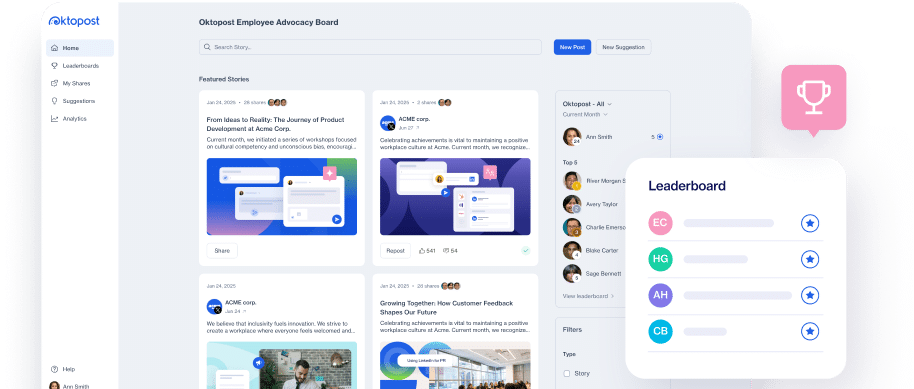
See how the Oktopost Employee Advocacy Board works below:
So, how much should an employee advocacy platform cost?
There is no universal number.
Program sizes differ. Pricing models differ. Requirements differ. And a $50 license that nobody uses can ultimately be more expensive than a $100 license that somebody does.
That is why comparing employee advocacy platforms solely on price per seat misses the bigger question.
Start with the total cost of the program.
Then ask how many employees will actually participate, whether that participation can be sustained as the program grows, how effectively those employees reach the audiences that matter, and whether you can connect their activity to commercial outcomes.
The economics of employee advocacy are not simply:
How much did the software cost?
They are:
What did we invest, how many people participated, who did they influence, and what did that influence contribute to the business?
In summary
The cheapest employee advocacy platform is not necessarily the one with the lowest license price. It is the one that delivers the strongest economics across adoption, participation, measurement, and commercial impact.
Therefore, when choosing an advocacy platform, do not simply ask what an advocacy seat costs. Ask what an active advocate is worth.
Book a demo to see how Oktopost helps B2B organizations build, scale, and measure employee advocacy, or get a quote based on the size of your program.