




- Programs that prove ROI connect employee activity to specific accounts in the CRM, not just total reach and impressions.
- Governance at scale means segmenting content and permissions by role and geography before launch, not after compliance flags a problem.
- Sustained participation depends on removing the fear of posting the wrong thing, and giving employees a reason to keep showing up after launch week.
- Secure executive sponsorship with a credibility argument, not a reach argument. Engagement multiples matter more to a VP of Sales than follower counts.
The marketing team’s biggest untapped channel is already on the payroll. Combined employee networks reach an average of 10 times more people than a company’s brand page, and content shared by individuals generates 8x the engagement of the same post from a corporate account. Yet most programs run on a Slack message, a shared Google Doc, and a Social Media Manager who ends every quarter chasing people down. That setup doesn’t hold beyond 50 participants and collapses entirely when you add regions, languages, or regulated business units. Getting employee advocacy program best practices right from the start determines whether you end up with 15% participation that quietly stalls or 60%+ sustained activation. A well-structured employee advocacy program turns informal sharing into a governed, measurable channel tied directly to pipeline growth.
Key takeaways:
- Programs that prove ROI connect employee activity to specific accounts in the CRM. Total reach and impressions rarely survive a CFO budget review; what holds up is pipeline influence from named target accounts.
- Governance at scale means segmenting content and permissions by role and geography before you launch, not after your legal team flags a compliance issue in Germany or your FINRA-regulated sales team shares something that triggers a review.
- Sustained participation depends on two things most programs skip: removing the fear of posting the wrong thing, and giving employees a reason to keep showing up after the launch-week excitement fades.
Employee advocacy program best practices: 7 steps to scale across teams and regions
Scaling an advocacy program requires getting the underlying systems right. The governance frameworks and measurement infrastructure you build in the first 90 days determine whether your program sustains above 60% participation or quietly plateaus at 15%. The seven employee advocacy program best practices below address each layer of that foundation.
- Step 1: Start with the metrics your CFO will care about, not just your CMO. Programs that retain executive budget after Year 1 define success in terms of pipeline influence and account engagement from target accounts, not impressions and shares. Before you configure a single content board, align marketing, sales, and compliance around the three or four business metrics that connect employee activity to revenue. If you’re at a FinTech running an ABM motion, that might mean tracking advocacy-influenced opens on target accounts in Salesforce. Get that agreed before the first employee invitation goes out.
- Step 2: Secure executive sponsorship with a credibility argument, not a reach argument. “Our employees have a combined network of 50,000 LinkedIn connections” isn’t a compelling business case for a VP of Sales. The argument that resonates is quantitative: employee content generates 8x more engagement than the same content posted from a brand page, and employee networks reach an average of 10 times more people than the company’s own followers. Employees are more likely to advocate consistently when they feel connected to company purpose. That matters for the adoption side of your pitch. For budget, show the executive team how advocacy expands trusted reach with target accounts, not just total followers.
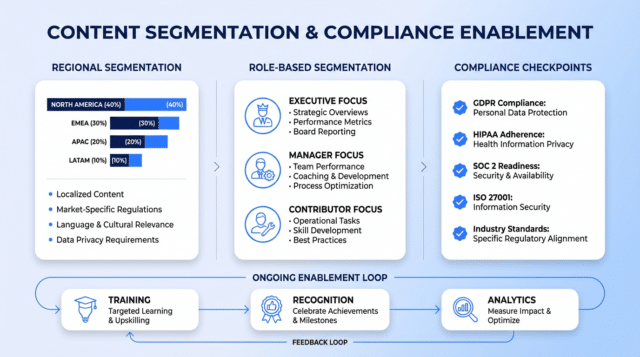
- Step 3: Map your audience before you build your content library. A 1,000-person company with offices in London, New York, and Singapore doesn’t need one advocacy program. It needs a program designed around segments: sales needs different messaging than customer success, and the UK team faces different compliance language requirements than teams in the US. Role-based permissions ensure employees see content relevant to their function and region, which reduces confusion and prevents a regulated-sector employee from sharing something their compliance officer hasn’t cleared.
- Step 4: Give employees a governed content library, then let them make it their own. The biggest barrier to advocacy participation isn’t apathy. It’s the fear of saying something wrong in public. Centralizing approved content in a governed advocacy platform addresses this directly. AI-assisted personalization lets employees adapt approved posts into their own voice without going off-script. A Sales Director at a FinTech company can share a thought leadership piece in a way that sounds like her, not like a press release, while the underlying message and compliance checks stay intact. This approach also scales brand consistency far more effectively than a quarterly “please share this” email.
- Step 5: Don’t launch company-wide on Day 1. Run a pilot with 20 to 30 engaged employees across two or three departments. These early participants surface the friction points in your onboarding flow and approval logic before those issues multiply across the full org. They also become your program champions, the people who tell colleagues “this takes two minutes” rather than “I’m not sure how it works.” Their feedback, collected in the first 30 days, is more valuable than any benchmark.
- Step 6: Build the retention loop into the program design, not as an afterthought. Advocacy programs that launch well and then quietly stall usually have the same problem: content goes stale after the first month, and there’s no visible recognition for the people who are participating. Long-term participation requires fresh content that’s relevant to what employees are working on. Monthly leaderboards showing the top 10 advocates by reach, shared in a company Slack channel, cost nothing and consistently move participation rates. Make participation visible and valued inside the organization.
- Step 7: Measure the program at the account level, not just the post level. Activation rates and total reach tell you whether employees are participating. They don’t tell you whether advocacy is working. Programs that prove ROI track engagement from named target accounts, influence on open opportunities, and revenue attribution through CRM integration. If a prospect at a target account has engaged with three employees’ LinkedIn posts before a discovery call, that signal belongs in Salesforce. It changes how the sales rep approaches the conversation. Connect your advocacy analytics directly to your CRM and marketing automation platform to make that attribution visible and defensible to leadership.
Employee advocacy program best practices for global compliance and governance
Scaling advocacy globally is where most programs hit their first real wall. Content written for a US sales team rarely resonates with a UK audience, and compliance obligations vary dramatically by region and industry. In regulated markets, a single governance misstep can pause the program entirely. The three practices below prevent each of these scenarios.
Segment content and permissions by role and region
Build content libraries tailored to specific departments and geographies. Sales teams need different messaging than HR. European teams require different compliance language than teams in North America, particularly around GDPR-adjacent disclosures and financial promotions rules in the UK.
In practice, role-based permissions mean that a 1,000-person company might have four or five distinct content boards: one for the sales team, one for the product and engineering team, one for the EMEA region, and one for executives. Each board contains only the content relevant to that group. A product manager in Berlin never sees messaging written for a financial advisor in Chicago. This serves as more than a compliance safeguard; it dramatically improves content relevance, which directly improves sharing rates.
Implement compliance guardrails with AI-powered review
For companies in regulated industries, advocacy compliance isn’t optional, and “we told employees what not to share” isn’t a defensible position. Financial services firms operating under FINRA recordkeeping requirements must retain records of employee social media communications and often require principal approval before any retail communication is shared. That means every post a registered representative shares needs to go through an approval workflow before it goes live, not after.
Automated compliance checks integrated into the content approval process catch potential issues at the content board level, before any employee sees the post. For FINRA-covered firms, this means flagging language that constitutes a “public appearance” or “retail communication,” routing it through a principal reviewer, and logging the approval with a timestamp for audit purposes. For companies without FINRA obligations, the same workflow catches off-brand language, unapproved product claims, and posts that reference competitors in ways the legal team hasn’t cleared.
Establish ongoing enablement and recognition systems
Scenario-based training that walks employees through real situations they’ll encounter outperforms generic social media policy documents every time. A 15-minute onboarding module that shows a sales rep exactly what an approved share looks like, how to personalize it, and what to do when they’re unsure produces far better compliance outcomes than a PDF policy handbook.
Regular content refreshes keep the program current. When the content boards go stale, participation drops. When participation drops, leadership loses confidence in the program. Treating the content curation function as a standing operational responsibility, not a launch task, keeps advocacy alive. Track data protection compliance when measuring employee participation across regions, particularly for EU-based employees where participation tracking must be handled carefully under GDPR. Monitor program health through participation rates, compliance scores, and content performance to give stakeholders a clear picture of where the program is working and where it needs attention.
What separates programs that prove ROI from those that stall
Employee advocacy delivers the greatest impact when it’s treated as a revenue-contributing channel, not a content distribution convenience. Programs that survive internal budget reviews share two structural characteristics: they measure at the account level from Day 1, and they have a named owner (typically a Social Media Manager or Marketing Ops lead) whose job explicitly includes running the program and reporting on it monthly.
Programs that stall typically have the opposite profile. Advocacy was added to someone’s responsibilities rather than owned as a function. Metrics were set around participation and reach rather than pipeline influence. Content boards weren’t refreshed after the first 90 days. None of these failures are dramatic. They accumulate quietly, and by the time leadership notices the drop-off, the program has been running on inertia for months.
Reviving a stalled program usually starts with the same question: who owns this? Clear ownership, a measurement framework tied to revenue, fresh content boards, and a recognition system that makes advocates visible are the governance elements that keep programs alive past the first year.
Oktopost helps enterprise B2B organizations scale employee advocacy with LinkedIn-first workflows, customizable governance controls, AI-assisted personalization, and deep CRM and marketing automation integrations. Teams can track advocacy performance across engagement, pipeline influence, and revenue attribution while giving employees an easy way to share trusted, relevant content at scale. Ready to put these employee advocacy program best practices to work across your teams, regions, and business units? Talk to the Oktopost team to see how B2B organizations use advocacy, governance, and attribution to turn employee engagement into measurable business growth.
Sisense used exactly this playbook to launch a global employee advocacy program, starting small and building genuine buy-in before scaling company-wide.