- Expertise exists, but participation sits at 36%
- Lack of time is the #1 barrier
- Lawyers want help with AI-assisted drafting
- LinkedIn now rivals the firm website
- Client relationships are the real payoff
The big picture
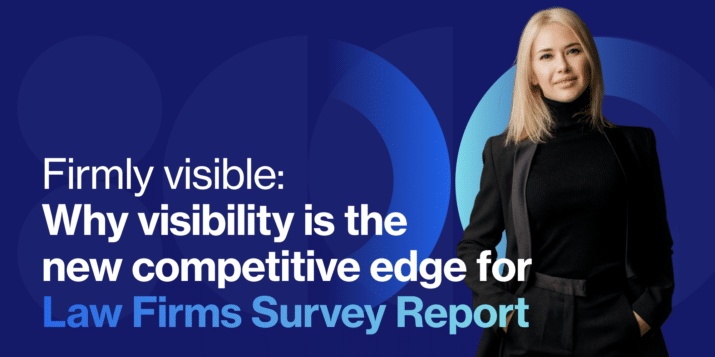
Oktopost’s Firmly Visible report surveyed 200 lawyers, legal marketers and business development leaders across the US and UK to find out what’s keeping lawyers from sharing what they know, and whether firms are fixing the right problem.
The infographic below sums it up in five findings. Each finding gets its own section below, with the numbers behind it and what they mean for a firm running a visibility program.
Download the full Firmly Visible report now.

Do law firms have an expertise problem or a visibility problem?
Lawyers have a visibility problem by a wide margin. 97% of respondents agree their firm produces more valuable expertise than ever reaches the market, which means almost nobody thinks the knowledge is missing.
Participation is where it falls apart. Average lawyer participation in visibility activities is 36%, and 77% of firms have fewer than half their lawyers participating. In most firms, a small group of partners and a handful of motivated associates carry the entire firm’s presence.
Only 22% say visibility is an expected part of everyone’s role, and that goes a long way toward explaining the 36%. Everywhere else, posting and sharing still belong to marketing, or to whoever happens to enjoy it. Nothing in a lawyer’s week makes room for a task that officially belongs to someone else.
Widening the base usually means looking beyond the partnership. Associates have smaller networks today, but they’re building the relationships that become tomorrow’s client work.
Why don’t more lawyers post on LinkedIn?
Many lawyers don’t post on LinkedIn mostly because they don’t have the time. Lack of time is the #1 barrier to participation, cited by 37% of respondents, and 34% of lawyers point specifically to billable-hour pressure. An hour spent drafting a LinkedIn post is an hour that doesn’t land on a timesheet. Lawyers do that math before every post.
Marketing teams have been reading the situation differently. 39% of legal marketers believe lack of confidence holds lawyers back, while only 17% of lawyers agree. That 22-point gap is the largest role-based difference anywhere in the study.
Oktopost Insight: Programs get built around the diagnosis. When marketing believes confidence is the barrier, the program fills up with coaching sessions, encouragement emails and LinkedIn workshops, all of which cost lawyers more of the one thing they say they lack. A program designed around the lawyer’s calendar starts somewhere else entirely, with drafts that arrive ready to approve and topics pulled from work the lawyer has already done.
What would get more lawyers participating?
Proof that it’s worth it and a faster way to do it would get more lawyers posting, according to the report.
The #1 enabler overall is a clearer demonstration of business impact, chosen by 28%. Lawyers are trained to weigh effort against outcome. When a firm can show that a post led to a client conversation, a referral or a speaking invitation, posting starts to compete with billable work on equal terms. Firms that tie social activity to measurable results give lawyers that evidence.
Speed is the other half. 29% of lawyers say AI-assisted drafting would help them participate more, compared with 17% of marketers. That 12-point gap makes sense, since lawyers are the ones paying the time cost. A partner who can turn a client alert into a draft post in a few minutes, then edit it in their own voice, has a realistic path to posting every week. Oktopost’s AI capabilities handle that kind of drafting inside a governed approval workflow.
Once the friction is gone, two motivations tie at 33%, building personal reputation and strengthening client relationships. Lawyers show up for their own brand and their own clients, so a program pitched purely as a firm marketing goal misses what actually moves them.
How important is LinkedIn to a law firm’s credibility?
LinkedIn now sits near the center of how firms get judged. 76% of respondents rate LinkedIn as very or extremely important to a firm’s professional credibility. 97% say its importance has increased, and 36% say it has doubled or grown exponentially.
Look at how clients evaluate law firm expertise. The firm’s website still leads at 52%. LinkedIn sits one point behind at 51%, with search engines at 49%. For years, the company website was the official record of what a firm knows. LinkedIn now carries almost equal weight, and it shows something a website can’t, which is what the firm’s lawyers actually think, week after week, in their own words.
For firms still treating LinkedIn as a secondary channel, the guide to B2B social media for law firms covers where to start.
What do law firms get back from visibility?
Law firms mainly get closer client relationships back from visibility. In fact, 38% name stronger client relationships as the #1 outcome of visibility, followed by stronger client trust (35%) and higher-quality leads (31%).
Lawyers feel it most. 46% of them name client relationships as the top outcome, compared with 30% of marketers. Marketers tend to measure visibility in leads and reach. Lawyers see it in the client who mentions a post on the next call, or the general counsel who forwards an article to a colleague.
In summary
Most firms already have the expertise and the readers. What they’re short on is lawyer time, and too many programs are still built around a confidence problem lawyers say they don’t have.
The full Firmly Visible report goes deeper on every panel, including the four priorities firms are using to build what the report calls the Visible Firm.
For more insights on legal marketing, contact us to request a demo.