



Why trust is critical in complex manufacturing sales
Manufacturing sales are built on trust. Large contracts, long timelines, technical risk, and multiple stakeholders mean buyers do not move quickly or lightly. They need confidence not just in the product, but in the people behind it.
At the same time, marketing leaders are under pressure to prove impact. Awareness alone is not enough. Activity needs to translate into measurable business outcomes.
This is where employee advocacy plays a uniquely powerful role.
When done well, employee advocacy strengthens credibility early in the buyer journey, supports long sales cycles, and delivers ROI that traditional channels struggle to match.
What employee advocacy really means in B2B manufacturing
Employee advocacy is often misunderstood as “getting employees to share company posts.” In reality, it is much more strategic. Employee advocacy has its greatest impact before sales engagement, when buying committees are still forming opinions. Buyers may never interact directly with employee content, but it quietly shapes perception, credibility, and internal discussions long before outreach occurs.
At its core, employee advocacy is about enabling employees to:
- Share expertise publicly
- Participate in industry conversations
- Humanize the brand through real voices
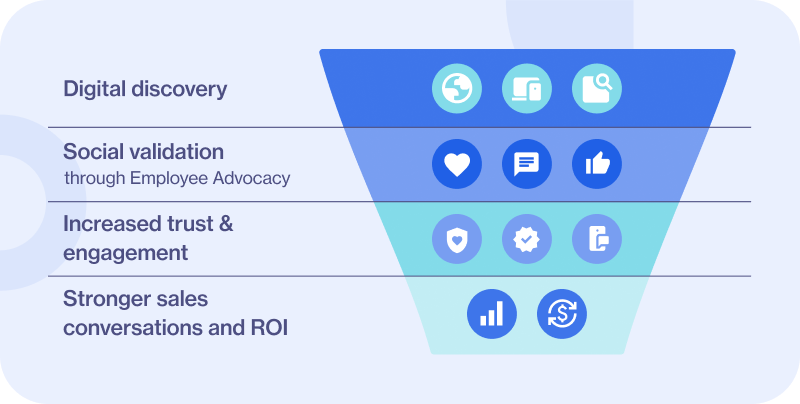
This matters because modern B2B buying is both digital-first and trust-driven.
Gartner describes today’s B2B buying journey as largely self-directed, with buyers gathering information independently across multiple digital touchpoints before engaging sales.
What employee advocacy adds is credibility.
Buyers may discover your brand through search or content, but they often validate it through word of mouth.
Why employee voices build credibility faster than brand messaging
Manufacturing buyers are cautious by necessity. Decisions carry operational, financial, and reputational risk. Marketing messages alone rarely remove that risk.
Employee voices help bridge the gap.
When buyers see engineers, sales leaders, and subject-matter experts sharing insights publicly:
- Expertise feels real, not theoretical
- Brands feel more transparent
- Trust builds earlier in the journey
LinkedIn’s B2B research shows that professional networks play a critical role in trust-building, particularly when decisions involve multiple stakeholders.
In manufacturing, this trust often develops quietly over time. Buyers may not engage immediately, but repeated exposure to credible voices influences perception long before outreach happens.
How employee advocacy supports long and complex sales cycles
Unlike short-cycle B2B sales, manufacturing deals unfold over months or even years. Committees change. Projects stall and restart. Budget cycles fluctuate.
Employee advocacy supports this reality by:
- Maintaining consistent visibility without sales pressure
- Reinforcing expertise across extended timelines
- Keeping brands present during periods of inactivity
This ongoing presence matters.
When buyers eventually re-enter evaluation mode, familiar brands with visible expertise feel safer than unfamiliar alternatives.
Employee advocacy allows marketing to stay active during the quiet parts of the funnel, supporting sales without forcing premature conversations.
The ROI impact of employee advocacy in manufacturing marketing
Beyond trust, employee advocacy delivers measurable business impact.
One of the clearest examples comes from Fujitsu. After implementing a structured employee advocacy program, Fujitsu saw:
- Employees share 10 times more social content
- A 70% increase in organic social reach
- A 3.6x higher ROI compared to paid social efforts
These results demonstrate a critical point. Employee advocacy does not replace paid or owned channels. It multiplies their effectiveness.
Content shared by employees travels further, feels more credible, and drives stronger engagement because it comes from people, not brands.
This amplification improves efficiency, especially in industries where paid reach is expensive and trust is hard to earn.
Why employee advocacy outperforms brand-only social media
Corporate social media accounts play an important role, but they have limitations.
Buyers expect company pages to promote. They are more skeptical of polished brand messaging.
Employee-shared content feels different. It enters feeds through personal networks and carries an implied endorsement.
Research consistently shows that people trust information from individuals more than from brands. In manufacturing, where credibility is paramount, that difference matters.
Employee advocacy helps marketing:
- Extend reach beyond brand followers
- Increase engagement without increasing spend
- Improve content performance across the funnel
It also helps sales teams warm conversations before outreach even begins.
Manufacturing marketing trust and ROI funnel
Common barriers to employee advocacy in manufacturing organizations
Despite its benefits, employee advocacy often stalls in manufacturing organizations due to understandable concerns:
- Compliance and governance risks
- Fear of inconsistent messaging
- Low employee confidence or participation
- Difficulty measuring impact
These concerns are valid, but solvable.
Successful advocacy programs are not informal or unmanaged. They are structured, supported, and aligned with business goals.
What an effective employee advocacy program looks like in practice
Strong advocacy programs in manufacturing share several characteristics:
- Clear structure and governance
Employees know what to share, how to share, and what is off-limits. - Content aligned with buyer needs
Advocacy content focuses on education, insights, and expertise, not promotion. - Sales and marketing alignment
Sales teams understand how advocacy supports the pipeline, not just awareness. - Measurement beyond vanity metrics
Success is tied to reach, engagement, influence, and contribution to revenue conversations.
When these elements are in place, advocacy becomes a strategic asset rather than a marketing experiment.
How employee advocacy aligns with modern workforce expectations
Employee advocacy also aligns with changing workforce dynamics.
McKinsey highlights that younger professionals increasingly expect digital-first engagement and opportunities to build their professional presence.
Advocacy programs give employees:
- A platform to share expertise
- Visibility within their industry
- A stronger connection to company success
This not only benefits marketing and sales but also supports employer branding and retention, particularly in competitive talent markets.
How Oktopost helps manufacturing teams scale employee advocacy
Oktopost helps manufacturing organizations build structured, measurable employee advocacy programs aligned with business goals.
With Oktopost, teams can:
- Curate and distribute content for employees to share confidently
- Enable advocacy across LinkedIn with minimal friction
- Measure the impact of employee activity on reach, engagement, and pipeline
- Maintain governance and consistency at scale
Employee advocacy already influences how manufacturing buyers evaluate vendors. Oktopost helps ensure that influence is intentional, measurable, and tied to revenue outcomes.
If you want to explore how employee advocacy can support trust and ROI in your sales cycles, request a consultation with a marketing expert and see how leading manufacturing organizations influence buying committees before sales get involved.