

- Running product, customer, and creative marketing out of one platform keeps messaging, proof points, and creative assets connected instead of drifting apart.
- Employee Advocacy turns customer wins and event pushes into distribution the moment they're ready, instead of sitting in a folder.
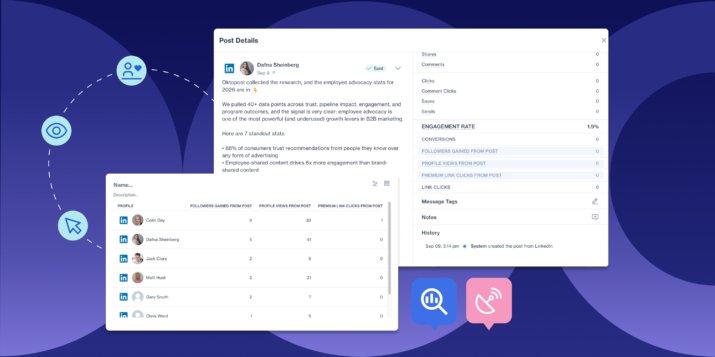
- Social Listening and Marketing Intelligence close the loop on product marketing, showing how a launch's messaging actually lands and ties back to pipeline.
- The Oktopost Claude Plugin removes formatting, scheduling, and repurposing work between each hat. Every message is still reviewed and approved by a person.
The big picture
My job title says “Product, Customer & Creative Marketing Lead.” I knew that’s what I was signing up for before I accepted the role.
I joined Oktopost a few months ago knowing this position would combine three functions that most companies split across three different people. That wasn’t a compromise I made, it was the reason I wanted the job. I like working across the full arc of a message: positioning it, proving it with real customers, then making it look good enough that people actually stop scrolling for it.
What I didn’t fully appreciate until I was a few months into the role was how much easier that combination becomes when the platform underneath it is built for exactly this kind of overlap. Positioning, customer proof, and creative distribution aren’t three separate disciplines inside Oktopost. They’re three views of the same social and advocacy engine.
That turned what could have been a stretched-thin role into one where each hat actively makes the other two easier to wear. This is what that looks like, hat by hat.
For another perspective on stretching a marketing role across multiple hats, see transitioning into a new social media manager role.
The product marketing role
Product marketing is the hat that sets the tone for the other two. Get the positioning right, and customer marketing has something worth proving and creative has something worth bringing to life.
Where Oktopost earns its keep here isn’t the launch documents themselves, it’s what happens after positioning goes live. Social Listening tells me how a new feature announcement is actually landing, what language prospects and customers use when they talk about it, and whether the message I wrote is the message people are repeating back. Marketing Intelligence closes the loop by tying that social activity back to the pipeline, so I’m not guessing whether a launch mattered.
That’s the part of product marketing nobody puts in the playbook: the listening and measurement work that tells you if the positioning actually worked. Having it live on the same platform as everything else means I’m not stitching together a spreadsheet from three exports just to find out.
The customer marketing role
Customer marketing is where the value of covering all three roles shows up most, because customer proof is only valuable if it actually gets in front of people.
Right now I’ve got a slate of video case studies in production, and I can’t share names yet, but I can tell you there are some big ones coming. What I can talk about is the workflow. Every customer story we produce doesn’t just become a page on the website. It becomes Employee Advocacy content the same day it’s ready, so the people actually closing deals have real customer proof to share on their own networks instead of waiting for a quarterly content refresh.
We also push it out through Social Publishing on our own Oktopost company pages, so the story is live on our corporate channels and in employees’ hands at the same time, rather than one feeding the other days later.
That matters more than it sounds. A case study sitting on a website page gets found. A case study shared by twenty employees gets seen. The distribution is the multiplier, and it’s built into the same platform I used to produce the asset in the first place.
The creative role
The creative hat is the one most people don’t expect a product or customer marketer to also be wearing, and it’s the one I probably enjoy most. I’ve been a graphics designer for most of my career.
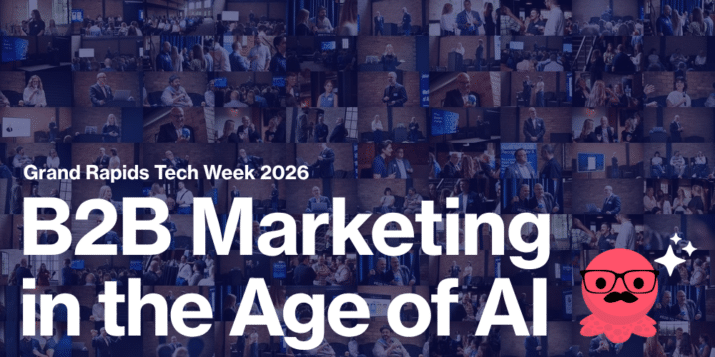
Right now that means building the entire creative push for our “B2B Marketing in the Age of AI” event at Grand Rapids Tech Week in September: social creative, print assets, the visual identity that carries the campaign from the first announcement through to the day of the event. I’m working on that one alongside Dafna, our Content & Community Marketing Manager, which is its own version of the same lesson: this works best when the platform makes it easy to hand off and build on each other’s work, not just when one person is doing everything solo.
Having Social Publishing and the content calendar in the same platform as everything else means the creative doesn’t get finished and then hit a queue while someone figures out where it goes. It gets built, scheduled, and pushed live across channels from the same place I planned the campaign in the first place.
Where Claude fits into all three
None of the three hats above changed because of AI. What changed is how much of the connective tissue between them I still have to do by hand.
The Oktopost Claude Plugin sits across all three roles for me. It’s the same assistant whether I’m turning a customer story into an advocacy post, drafting variations of event creative for different channels, or pulling listening data into a format I can actually act on. I’m not switching tools or re-explaining context each time. I brief it, it drafts, I edit, it publishes into the platform I’m already working on.
The value isn’t that it does any one job better than I would. It’s that it removes the tax of doing three jobs in three different places.
What this setup doesn’t do
I don’t want this to read as “AI replaced two of my three roles.”
It didn’t.
Claude isn’t deciding what our product positioning should be. It isn’t choosing which customer stories matter or what a campaign should look like. It isn’t making the creative calls that make a piece of content actually land.
What it is doing is clearing the repetitive work that used to sit between having a good idea in one part of my role and getting it in front of the right audience through another. The formatting, the repurposing, the scheduling, the first draft.
Every message still gets reviewed. Every asset still gets approved. I’m still the one deciding what’s on brand and what isn’t.
Three jobs, one platform
I didn’t take this role expecting it to get easier. I took it because I wanted the range: a job where positioning, customer proof, and creative all sit on my desk at once, instead of being split across three people who rarely compare notes.
A few months in, the thing I didn’t expect is how much that range is amplified by having one platform underneath all three. Product marketing informs customer marketing. Customer proof feeds creative. Creative gets distributed through the same advocacy and publishing tools I used to plan the campaign in the first place. Claude sits across all of it, handling the parts that don’t need a strategist’s judgment, just consistency.
I still plan. I still write the brief, sometimes for myself to act on. I still make the final call on every single hat I wear.
What I’ve got now is more time to actually enjoy wearing all three.